

Technical GEO: Discoverability, Accessibility and Readability
Rewriting the Rules of the Game in the AI Era
The revolution sparked by Large Language Models (LLMs) is radically reshaping the dynamics of online search, ending Google’s long-standing monopoly and having a powerful impact on users’ purchasing decisions.
For years the technical SEO agenda has been dictated by Google, whose constant evolution has gradually made it possible to embrace many website development choices that were once strict limitations. Take, for example, any solution that requires code execution for proper page rendering or for injecting meta information and structured data: through its rendering service, Google is able to execute the scripts needed to generate the Document Object Model (DOM) and, in most cases, to analyse and index page content without issues.
Today, however, the priority shifts: we need to focus on the accessibility, discoverability and readability of our content for AI systems, which operate with less sophisticated logic and technology than the Mountain View giant.
Accessibility: the New Rendering Challenge
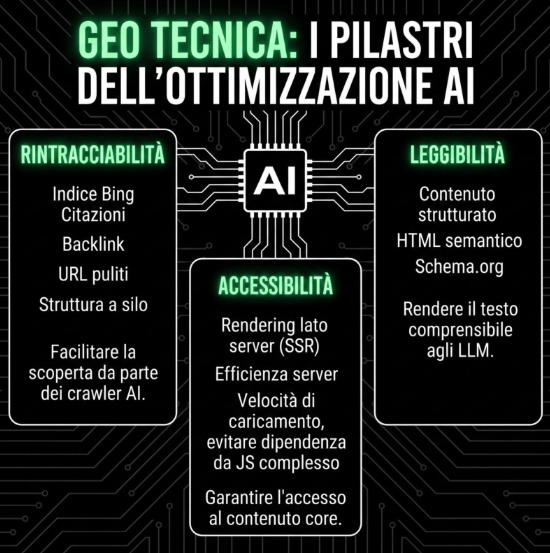
The first and most crucial aspect of technical GEO (Generative Engine Optimization) concerns the accessibility of content. New AI-based engines such as ChatGPT are characterised by a limited or non-existent ability to execute complex scripts for dynamic content rendering.
AI-based engines like ChatGPT rely on content-analysis technology that is decidedly less advanced than that of traditional search engines. As of today, LLMs are not able to access content that requires the execution of complex scripts in order to be displayed.
While Google handles code execution and page rendering for indexing very well — Bing somewhat less so, although it does offer rendering capabilities — LLM engines today cannot access content that depends on complex scripts to be rendered. A technical audit through a GEO lens must therefore reclassify as serious issues any technical solutions that, while compliant with Google’s best practices, prove to be too advanced for LLMs.
Other aspects to consider are loading speed and web server efficiency, which affect visibility in traditional search engines but, in the case of LLMs, can lead to more troublesome consequences.
Classic search engines use a spider to analyse content, which is then stored in an index that the algorithm queries to retrieve answers to user searches. If a crawl request fails due to a temporary issue, the engine’s bots will retry the operation several times before giving up and dropping the resource URL from their crawling list.
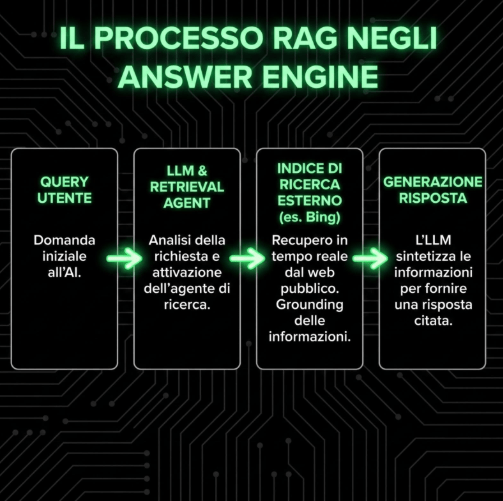
The Answer Engines that integrate LLMs use the RAG (Retrieval-Augmented Generation) framework to source information. When they do so in real time from the public web, they necessarily rely on existing search engine indexes, such as Bing, since they do not have their own global index. If, while attempting to access a page, that page does not respond within a reasonable timeframe, their bots abort the operation and look for the information elsewhere. This means that content that fails to load immediately and correctly risks, effectively, remaining invisible.
Discoverability: Getting Found by LLM Bots
Content discoverability for LLM engines follows a completely different model from what happens with traditional engines, which use specific tools such as sitemap.xml files or direct URL submission through dedicated webmaster tools like Google’s Search Console.
Because they have no index in which to store information collected online, LLMs do not support inclusion tools like sitemap.xml, nor do they offer the option to request the indexing of web pages.
To increase the chances that our information is “seen” by ChatGPT — which can rely on Bing’s index to generate answers — it is essential to make the most of all the inclusion tools the latter offers.
Beyond these measures, discoverability is intrinsically tied to the authority and trust a brand has built online. A site with strong external signals — such as quality citations and backlinks from other sites and social media — is perceived as authoritative and is more likely to be selected and cited by LLM engines, which prefer to pull information from domains considered reliable.
Readability: Adding Context to Content
Finally, readability concerns the ease with which an Answer Engine can extract, understand and synthesise content in order to include it in a response. Among the goals of GEO activities is making a site’s body of documents as citable, clear and trustworthy as possible.
Another relevant technical aspect involves structured data, a kind of labelling that makes it possible to explicitly declare the nature of certain elements within the HTML source of web pages. For years SEOs focused solely on a small number of types and properties supported by Google, with particular attention to those that triggered rich results (carousels, rich cards, graphical elements such as review stars, etc.). However, the arrival of LLMs has opened up new opportunities to leverage this tool in order to make site content more visible in AI-based engines, which use any meta-information that helps them better understand the content of a page.
To grasp how much these opportunities have expanded, consider that the schemas currently available comprise over 800 types and 1,500 properties.
An interesting aspect currently under discussion is the introduction of an LLMs.txt file containing key information about the domain in markdown format. This file — which, like robots.txt, should be placed in the root folder of the site — could in theory facilitate real-time retrieval of important information by LLMs. As of today, however, the major LLM providers have not confirmed support for this file, and there is also a potential risk of abuse in the form of spam from webmasters.
The AI revolution has lengthened the list of technical checks, radically changing the criteria by which solutions once considered best practice are evaluated. It’s time to monitor brand visibility in an answer-first environment.
Conclusions
In conclusion, it is undeniable that the AI revolution in online search has already had a significant impact on the technical optimisation activities aimed at improving site visibility within responses from the new models — extending the checklist and radically reshaping the criteria by which certain technical solutions, once aligned with best practices, are now judged.
After completing baseline technical optimisation, it is necessary to assess the impact of these activities on visibility within LLM responses, through a form of monitoring that is markedly different from the classic approach of traditional rank analyzers. Since this type of monitoring also — and above all — serves to shape content strategies in the new landscape, we will have the chance to explore the topic in more depth in the article dedicated to the impact of the AI revolution on content strategy.
Coming soon: The Impact of AI on Content Strategy
More articles in AI & SEO
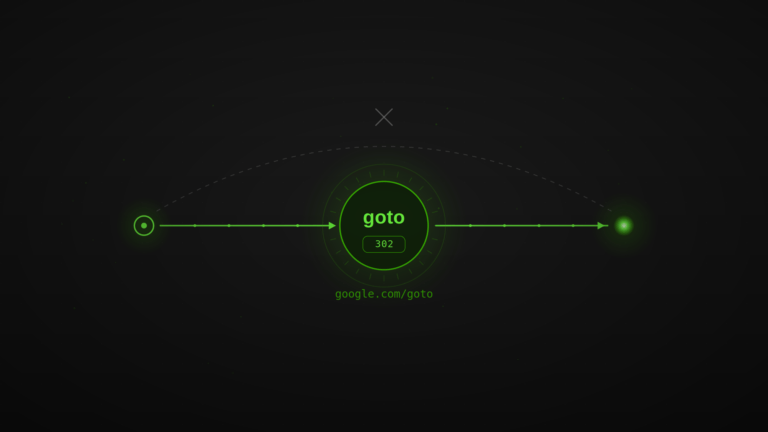
Google.com/goto: the redirects changing the rules of the game for SEO
Google.com/goto : the redirects changing the rules of the game for SEO What they are, why Google introduced them, and what they mean for anyone working in organic search 1. The appearance...
Read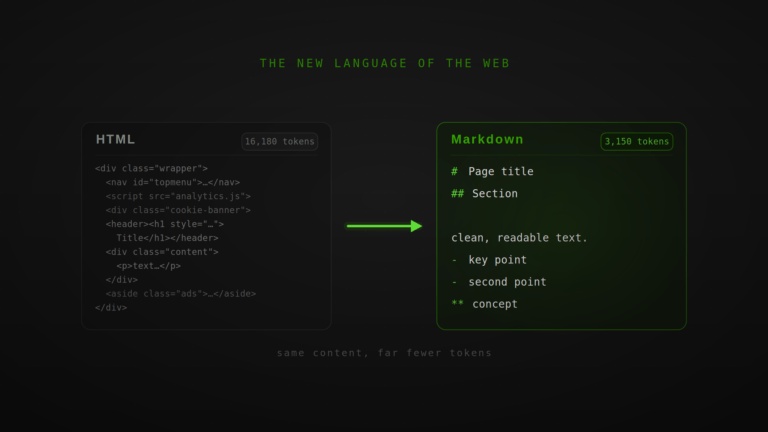
Markdown for AI Agents: the new language of the web
Markdown for AI agents: the web’s new language The web has always been built for human beings. HTML pages loaded with menus, scripts, advertising banners, tracking tags: everything designed for a browser...
Read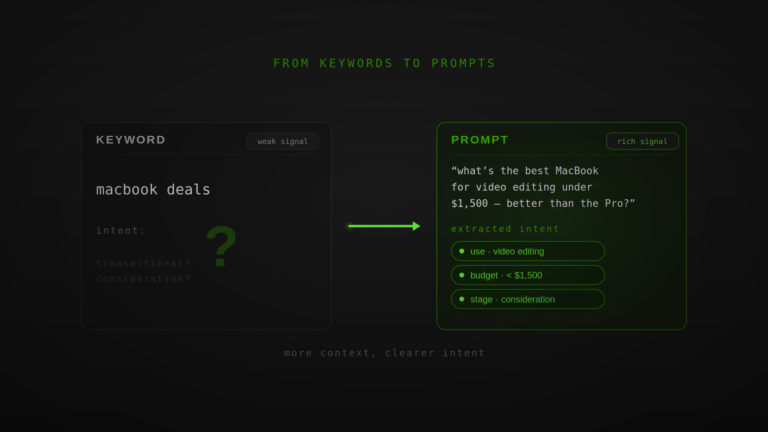
Prompt Analysis: a new world to explore
Prompt analysis: a new world to explore Search analysis was born as a tactical tool for ranking on search engines. With the advent of chatbots and large language models, the raw material...
Read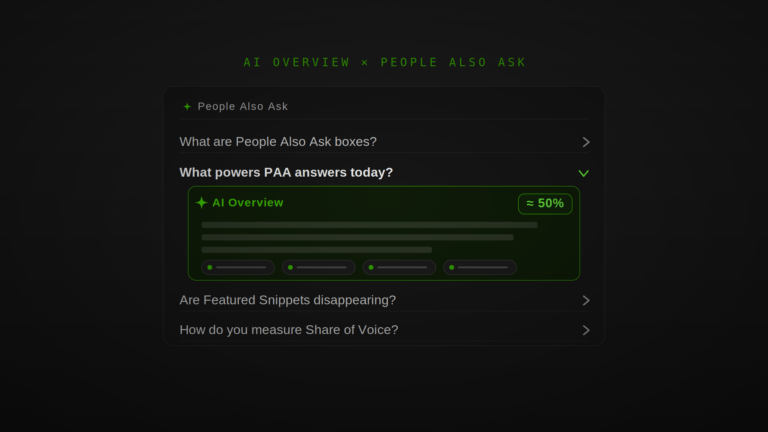
The impact of AI Overview on People Also Ask answers
The impact of AI Overview on People Also Ask answers People Also Ask boxes first appeared in Google's results in the United States in 2015. After an initial phase of testing and...
Read
Google, Bing and GEO: who is right?
Google, Bing and GEO : who is right? For a while, as the debate among digital marketing professionals raged over the scope of GEO (Generative Engine Optimization) and AEO (Answer Engine Optimization)...
Read
Google Search Console and Bing Webmaster Tools: Governing Access to Your Data
Google Search Console and Bing Webmaster Tools: Governing Access to Your Data Saying we need to pay attention to who can access our organic performance data and all the other information offered...
Read