

The Impact of AI Overview on Blue Links and Featured Snippets
Since the arrival of AI Overview in Italy a year ago — on 26 March 2025 — a large share of the digital marketing community has agreed that this new SERP element, which offers direct answers to users’ informational needs, would change forever the nature and function of the SEO lever, with everything that follows in terms of KPIs — the metrics used to measure the effectiveness of optimisation activities.
AI Overview (from now on AIO for short), moreover, could turn out to be an intermediate step rather than the end point of the transformation of Google from search engine to answer engine, a process that began many years ago. With AI Mode, Big G could in fact become a conversational environment very similar to that of the various ChatGPTs, Perplexitys and so on. An environment in which the user could find every answer to their needs and even delegate every assessment and the resulting action to the AI.
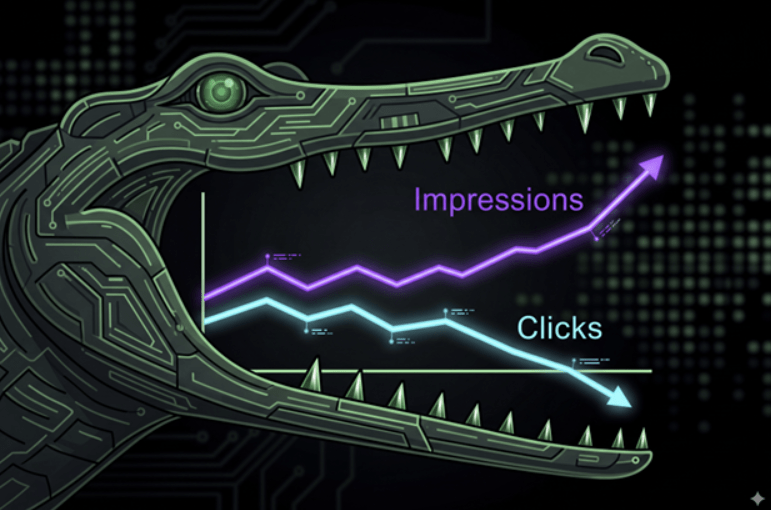
The first consequence of this epochal shift can be seen in the data offered by Google Search Console: stable, if not rising, impressions, a drastic reduction in clicks driven by organic results, and the resulting collapse of CTR. The widening gap between the purple impressions line and the blue clicks line creates an image reminiscent of the open jaws of a crocodile — which is why people quickly started talking about the “crocodile” effect1.
This scenario inspired a conclusion embraced by many in the industry: SEO — rebranded as GEO in “answer” contexts — is no longer a lever aimed at generating qualified traffic, but a useful tool for developing relevance, that is, Awareness and Leadership of Thought.
But is that really how things stand? Broadly yes, but reality is highly imaginative and tends to escape any generalisation or excessive simplification. The team I have the honour of coordinating has always had the habit of monitoring the landscape and storing all the information that, in our judgement, can help make sense of complex realities.
In the last two years alone we have analysed and stored over 13 million SERPs — desktop and mobile — relating to roughly 7 billion searches across about fifteen countries and several business sectors. The data refers to clean, classified keyword sets; the SERPs and search volumes, suitably redistributed across variants and misspellings, are drawn from DataForSEO.
Let’s let the data speak. The charts that follow analyse the share of three listing types (classic Blue Link, Featured Snippet and AIO) at the top position of Google’s organic results (paid results are excluded).
Let’s start with the overall scenario given by all recorded data points — both desktop and mobile, across all countries analysed and every industry.
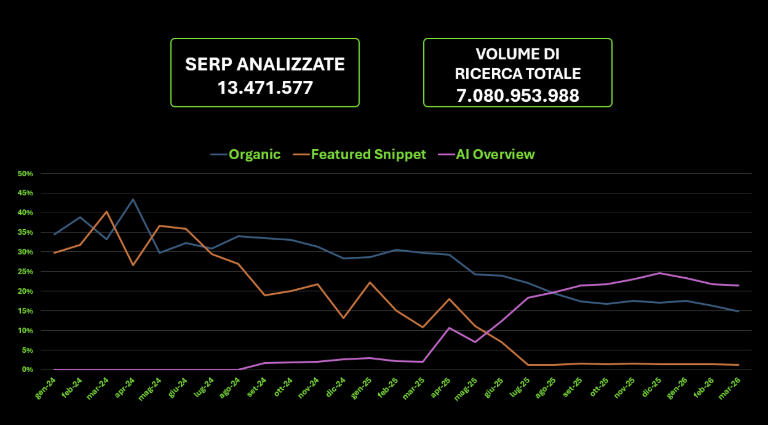
Setting aside the inevitable data gaps in some countries where AIO was rolled out very early starting in May 2024, the chart highlights the following macro-phenomena:
- progressive increase in AIO’s share of the top position: its rollout has been gradual across countries, but over the last 12 months it has gone from 10.6% in April 2025 to 21.46% in March 2026;
- massive shrinking of classic Blue Links, which from 29.3% in April 2025 have fallen to 14.8% in March 2026. Two years ago they accounted for 43.4% of top rankings on Google;
- drastic reduction of Featured Snippets: from 18% in April 2025 to 1.2% in March 2026.
It is plainly evident that the rollout of AIO has triggered the vertical collapse of Featured Snippets, the “Answer First” type of listing through which Google tries — or perhaps we should say “used to try” — to offer answers to users’ informational needs directly inside the SERPs, borrowing them from indexed web pages.
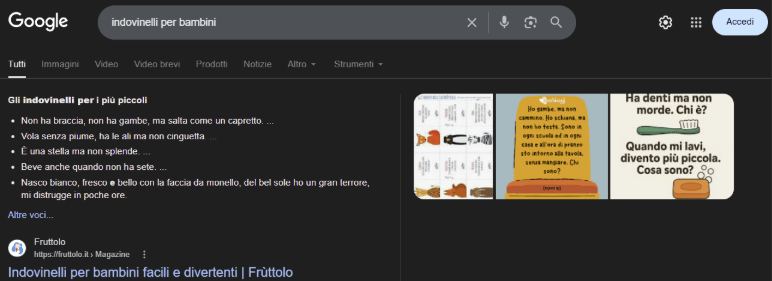
As you can see in the image above, just below the — generally concise — extract from the page that, according to Google, may answer the query, you find the link to the cited source, which often drives significant CTR (click-through rate, the ratio between link impressions and clicks received).
Overall, the combined share of Blue Links and Featured Snippets has shrunk by more than two-thirds, going from just under 50% to 16% — which easily explains the “crocodile” effect mentioned earlier.
If we turn the spotlight on Italy, we can clearly see that AIO, which arrived at the end of March 2025, took hold rapidly. If we consider the period January 2025 – March 2026, in which we gathered more than 6 million SERPs tied to just under 3 billion searches:
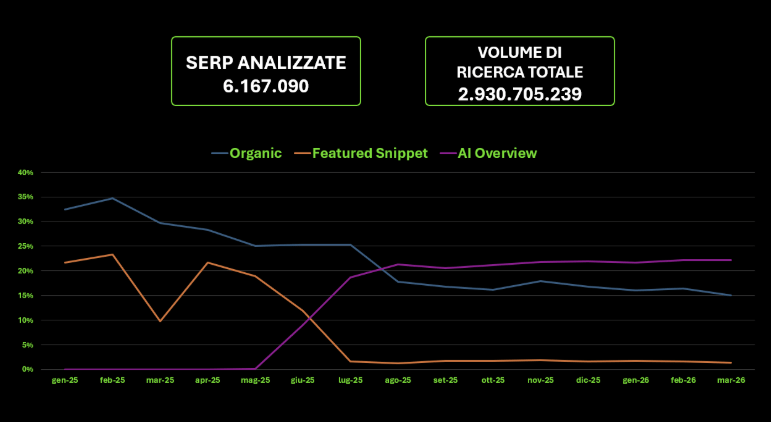
In April 2025, immediately after the release of AIO, Blue Links (28.3%) and Featured Snippets (21.7%) together dominated 50% of top positions on Google. By March 2026 they had dropped to 16.4% (15.06% Blue Links, 1.34% Featured Snippets), while AIO covers 22.2% of top positions.
This average is the result of sectors in which Featured Snippets and AIO are essential for organic acquisition, alongside sectors in which, to date, both result types play a completely marginal role. Let’s start with an area in which the arrival of AIO has practically wiped out the click-driving capacity of classic listings: Pharma. We’re talking about all those user queries aimed at finding information on causes, symptoms and treatments of all kinds of conditions — a topic that has long been the focus of content strategies by vertical and generalist publishers, institutes and clinics, as well as pharmaceutical manufacturers.
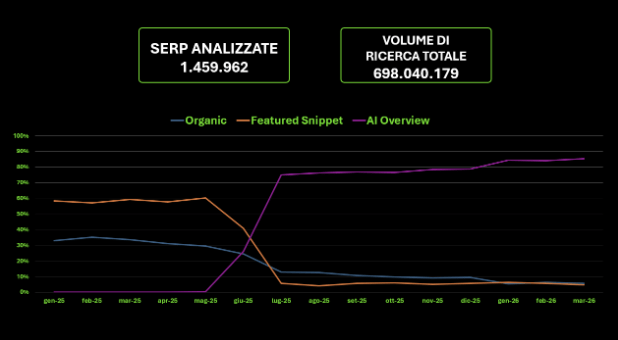
The data is inexorable: at the start of March 2025 more than 90% of top positions on Google were held by Featured Snippets (59%) and Blue Links (33%), while by March 2026 their combined share amounts to just 10.5% (5.7% Blue Links and 4.8% Featured Snippets). AIO, by contrast, jumped to 75% within three months, and then expanded to dominate top rankings with a share of 85.3% in March 2026. The impact on the acquisition capacity of disease awareness editorial content has been devastating: although still holding good rankings, the editorial sections of these sites have seen massive traffic drops, in some cases above 60%.
We’ll dig deeper into the topic in the next article, but I have to clarify one point: this data, however limited to a specific sector and country, doesn’t carry the same consequences in every situation. Search intent — and its depth — is an element that can make the difference even when the SERP morphology is the same. In the case of a shallow search intent, like “remedies for the common cold“, it’s reasonable to think that the user will tend to rely exclusively on the ready-made answer from AIO. If, on the other hand, they are looking for information on a serious condition, the idea that they would settle for the AIO summary without exploring the cited sources or those featured in the search results looks far less likely.
For now let’s set aside this aspect linked to the depth of search intent and return to the SERP scenario. If we move to a sector like Food, where the main type of content driving traffic is recipes, the scenario changes dramatically. In the period immediately before the release of AIO, the “Recipes” results in the chart below — that is, the Recipes Gallery in the “Search appearance” report in GSC — were responsible for the vast majority of traffic. On a sample of 3 million organic clicks from one of our projects, the share of clicks driven by rich cards in the period February – April 2025 turns out to be just over 94%.
The following chart refers to the period January 2025 – March 2026.
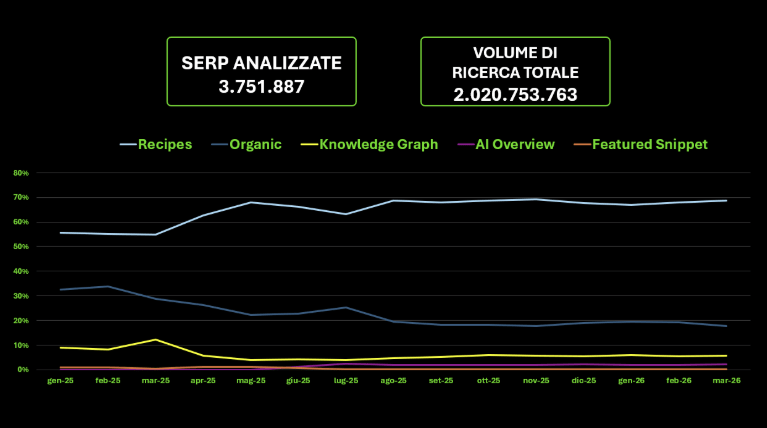
As you can see, AIO is barely present and as of today shows up as the top listing in only 2.2% of searches — very often of the how-to type (e.g.: “how to clean squid“, “how to boil potatoes“, etc.). Classic Blue Links, although down, have been holding for months at around 18%. What has actually increased its share among top listings is the recipe rich cards, which in our experience narrow the fight for the click to the first three sites that appear in the unexpanded gallery panel:
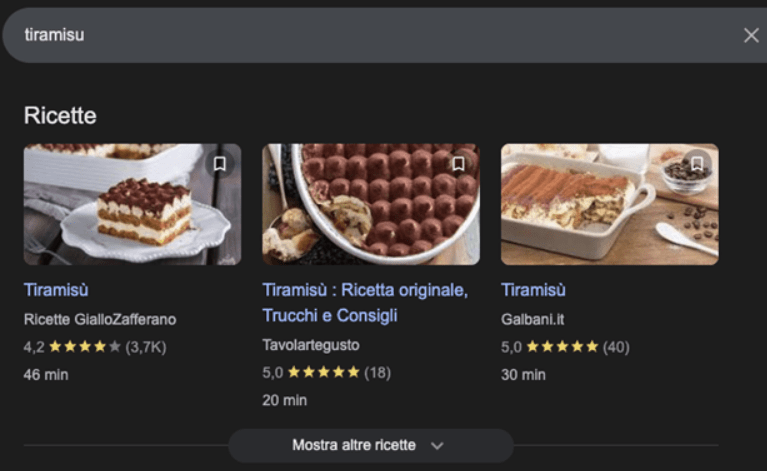
In this not exactly negligible sector by size, AIO has, at least for now, had a substantially negligible impact and winning the click essentially depends on how the listing looks inside the carousel (photo, title, reviews, additional information such as preparation time).
We’ve put quite a lot on the table, so for now we can stop here — we’ll have the chance to analyse plenty more data, continuously updated, in upcoming articles.
1. On 3 April, while this article was awaiting publication, Google candidly announced a “logging error” that had inflated the impressions recorded by GSC starting in May 2025, and stated that the error will be fixed in the coming weeks. In light of this disclosure, any assessment based on GSC data will have to be re-verified against the post-fix figures.
More articles in AI & SEO
Google.com/goto: the redirects changing the rules of the game for SEO
Google.com/goto : the redirects changing the rules of the game for SEO What they are, why Google introduced them, and what they mean for anyone working in organic search 1. The appearance...
Read
Markdown for AI Agents: the new language of the web
Markdown for AI agents: the web’s new language The web has always been built for human beings. HTML pages loaded with menus, scripts, advertising banners, tracking tags: everything designed for a browser...
Read
Prompt Analysis: a new world to explore
Prompt analysis: a new world to explore Search analysis was born as a tactical tool for ranking on search engines. With the advent of chatbots and large language models, the raw material...
Read
The impact of AI Overview on People Also Ask answers
The impact of AI Overview on People Also Ask answers People Also Ask boxes first appeared in Google's results in the United States in 2015. After an initial phase of testing and...
Read
Google, Bing and GEO: who is right?
Google, Bing and GEO : who is right? For a while, as the debate among digital marketing professionals raged over the scope of GEO (Generative Engine Optimization) and AEO (Answer Engine Optimization)...
Read
Technical GEO: Discoverability, Accessibility and Readability
Technical GEO: Discoverability, Accessibility and Readability Rewriting the Rules of the Game in the AI Era The revolution sparked by Large Language Models (LLMs) is radically reshaping the dynamics of online search,...
Read