

Fan-out and RRF: How LLM Models Break Down Queries and Select Sources
The Evolving Dynamics of Online Search
Unlike traditional ones, AI-based search engines provide direct answers to the questions users ask. This isn’t the only factor contributing to the true revolution in the dynamics of online search that has characterised recent decades. On the one hand, the improved understanding capabilities of LLM models encourage increasingly structured questions, built around conversational language. On the other, the response they provide is a summary of the information the AI engine has available — that is, the documents from its training corpus, supplemented as needed with information retrieved in real time from the web.
Where once the typical lifecycle of a query included, as a necessary step, the choice of one of the results offered by the search engine, followed by a click on the “blue link” and the consumption of content on the linked web page, today the user’s query is followed by a direct answer that prompts a continuation of the conversation through follow-up questions rather than a visit to any property. Clearly this is a general concept and there are many exceptions which we will have the chance to dig into in dedicated articles, but “broadly speaking” this is how things stand.
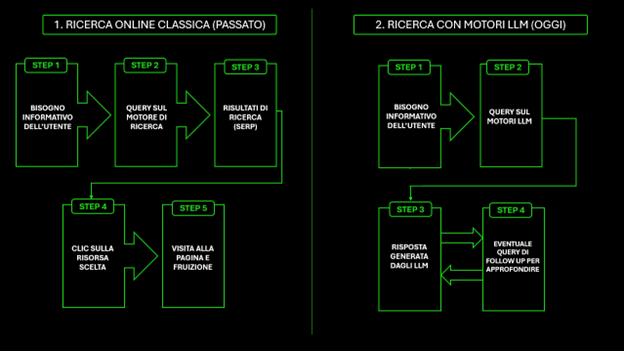
If in the era of the ten blue links the direct goal of SEO activities was to generate qualified traffic — visibility and traffic were, in effect, two sides of the same coin — in the age of answer engines the real point is to be relevant and to maximise visibility among the sources used by LLM models to assemble their responses.
To do this, we need to try to better understand the inner workings of AI-based engines — that is, how they select and retrieve the information they need to generate an answer. At the heart of this process are two key concepts: Query Fan-out and Reciprocal Rank Fusion (RRF).
What Is Query Fan-out and Why It Matters
Query Fan-out is an information retrieval technique used by AI-based search engines to break down a complex user prompt into multiple distinct sub-queries.
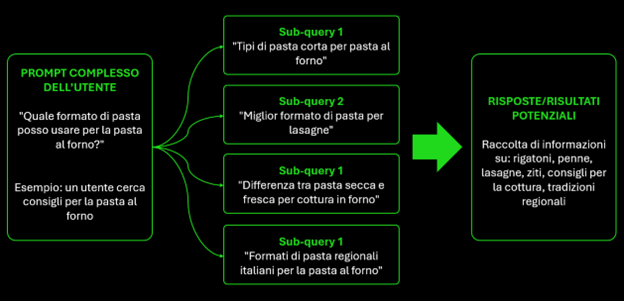
Instead of relying on a direct, linear match with the original search string, the system breaks down the user’s elaborate prompt into a series of sub-questions and runs the corresponding queries in parallel to gather information from different angles (for example technical specifications, reviews, prices) and synthesise them into a single complete answer.
You could think of the fan-out system as an automated research assistant capable of anticipating the user’s follow-up questions in order to reduce the model’s ambiguity and hallucinations.
What Is Reciprocal Rank Fusion (RRF)
Reciprocal Rank Fusion (RRF) is a simple but extremely powerful algorithm used inside RAG (Retrieval-Augmented Generation) systems to intelligently combine search results from multiple queries. Its main advantage is the ability to take in lists of results generated through different methodologies and produce a single final ranking. This isn’t cutting-edge technology — it first appears in a scientific paper from 2009.
When Fan-out generates several sub-queries, the system retrieves lists of documents for each of them in parallel. At this point the RRF mechanism kicks in, fusing the results by assigning a score in such a way as to reward documents that consistently rank high across multiple different searches. In short, the resources (web pages) that appear repeatedly in the search results both for the main query and for the sub-queries distilled by Fan-out earn a higher score, dramatically increasing the chances of being cited in the final response.
A recent study based on 15,000 prompts shows that of the more than 500K documents retrieved using around 43K sub-queries, only 15% made it through the bottleneck of RRF and ended up among the sources cited in ChatGPT’s responses. An aspect not to be overlooked: the same study seems to confirm that good old SEO Foundation remains central even when it comes to building visibility in AI-based engines: over 43% of the cited pages hold a top position on classic Google SERPs for one of the sub-queries.
Another particularly interesting data point is that almost a third of the pages cited in the final AI responses appear exclusively in the fan-out query results, and not in the search results generated by the original prompt. Finally, the sub-queries produced by fan-out are often zero-volume according to traditional search-intelligence tools, making them tempting GEO opportunities that are hard to identify with the classic approach to keyword research.
How Fan-out and RRF Shape Content Optimisation
The mechanism described suggests a slightly more nuanced approach than the “classic SEO” one, which all too often is improperly associated with the concept of “target keyword“.
Optimising for the “target keyword” in fact represents a prehistoric approach used back when search engines were not able to “understand” natural language — neither in the user’s queries nor, even less, in the content of the web pages they analysed — and based their relevance judgements on plain text “matching”. Even before the arrival of Hummingbird or NLP models such as BERT or MUM, search engines like Google tried to contextualise the “target keyword” and link it to a conceptual entity. If a page talked about “jaguar” and then mentioned horsepower, Google “understood” that the term referred to a car, while in the presence of words like “jungle” or “predator” it was able to disambiguate correctly and grasp that the topic was an animal.
Even when the means used for better natural-language understanding by engines were barely sketched out, the content optimisation approach moved beyond the perimeter of the “target keyword” and extended the optimisation field to all the closely related terms: synonyms, related conceptual entities.
What is it that really changes in content optimisation activities in light of the Fan-out and RRF pairing?
- Once the topic has been identified, simulating fan-out helps us define its perimeter and structure — that is, the sequence of concepts to include in our content to make it complete and exhaustive.
- When drafting the content, it is useful to address the core of the informational need first and then go on to cover all the relevant sub-queries, ideally through well-structured paragraphs and hierarchical headings (H2, H3).
- According to some industry professionals — though contradicted by Google spokespeople who are not exactly disinterested — it would be useful to write in “chunks” (fragments): each text block should be semantically cohesive and self-sufficient, so that it can be extracted, understood independently and merged by RRF without losing its meaning. Also bearing in mind “passage indexing” (more accurately “passage ranking”), a technology introduced by Google in 2021 that allows the algorithm to understand and rank specific passages or sections within a web page, rather than limiting itself to evaluating the entire page as a single entity, the idea doesn’t seem so far-fetched.
- The content must answer, either implicitly or explicitly — for example in the form of FAQs — all the questions raised by the sub-queries.
As you can see, these steps present a few small but substantial differences compared to the classic content optimisation approach, because while the end user — the ultimate recipient of the content — remains the same, what changes is the inner workings of the interface that allows us to intercept them while they search for information on AI-powered engines. In particular, content construction must take Fan-out and the RRF mechanism into account in order to maximise the chances of being used as sources for the generation of LLM responses and thus enable exposure of our brand in the new contexts of online information search.
Conclusions
The GEO era imposes a fundamental shift from the logic of the “ten blue links” to a focus on authority and citation-worthiness. AI engines don’t read content in order to index it by keyword, but to unpack it, extract meaning through Fan-out and assess its cross-cutting relevance with Reciprocal Rank Fusion.
Aligning content production with these new dynamics isn’t an advanced technical option, but the only option for improving the relevance of our brand in generative search responses.
More articles in AI & SEO

Google.com/goto: the redirects changing the rules of the game for SEO
Google.com/goto : the redirects changing the rules of the game for SEO What they are, why Google introduced them, and what they mean for anyone working in organic search 1. The appearance...
Read
Markdown for AI Agents: the new language of the web
Markdown for AI agents: the web’s new language The web has always been built for human beings. HTML pages loaded with menus, scripts, advertising banners, tracking tags: everything designed for a browser...
Read
Prompt Analysis: a new world to explore
Prompt analysis: a new world to explore Search analysis was born as a tactical tool for ranking on search engines. With the advent of chatbots and large language models, the raw material...
Read
The impact of AI Overview on People Also Ask answers
The impact of AI Overview on People Also Ask answers People Also Ask boxes first appeared in Google's results in the United States in 2015. After an initial phase of testing and...
Read
Google, Bing and GEO: who is right?
Google, Bing and GEO : who is right? For a while, as the debate among digital marketing professionals raged over the scope of GEO (Generative Engine Optimization) and AEO (Answer Engine Optimization)...
Read
Technical GEO: Discoverability, Accessibility and Readability
Technical GEO: Discoverability, Accessibility and Readability Rewriting the Rules of the Game in the AI Era The revolution sparked by Large Language Models (LLMs) is radically reshaping the dynamics of online search,...
Read