

AI Overview, CTR Decline and the Depth of Search Intent
In the previous article we began analysing the impact of AI Overview on classic Blue Links and Featured Snippets — listings of different kinds but with one thing in common: a solid ability to convert impressions into clicks within the context of organic search on Google.
In broad terms, the impact of AI Overview has been substantial and has marked a genuine milestone in the process of transforming Google into an answer engine, but not every topic sector has been affected by this earthquake to the same extent.
In Italy, for instance, the analysis of a panel of more than 6 million SERPs from January 2025 to March 2026 shows an overall impact of AI Overview on top organic rankings just above 22%. When you isolate individual verticals, however, completely different scenarios emerge.
In the health sector, for example, the arrival of AIO marked a drastic contraction of Blue Links and Featured Snippets, which fell from over 90% in March 2025 to a meagre 10.5% twelve months later. By contrast, AIO now dominates 85% of SERPs.
In the recipes sector, on the other hand, AIO appears in the top position in only 2.2% of the SERPs analysed (March 2026), while the Recipes Gallery has actually strengthened its presence, going from 54.8% in March 2025 to 68.7% in March 2026.
These figures make it clear that generalisations don’t help us understand what is happening and prevent us from forging axioms that hold up for everything and everyone. Statements like “focusing on traditional queries is no longer useful” or “SEO is no longer a lever for generating qualified traffic” should be recalibrated according to the context which, as we have seen, can vary enormously.
But there is another aspect that, for SERPs of similar morphology, could significantly affect the actual ability of organic visibility (rankings) to convert into clicks — that is, the CTR (click-through rate): user search intent.
In the previous article we touched on this rather intuitive concept: when the user isn’t particularly motivated or is in a hurry, and their search intent can be satisfied with quick, concise answers, AI Overview can become a tool capable of fully meeting that need, sparing them the time required to pick a link in the SERP and verify, by visiting it, whether the suggested page actually contains the answer to their question.
In the past, both publishers and “SEO-oriented” editorial projects deployed on other types of sites have always targeted relevant topics selected on the basis of query search volumes, regardless of the depth of search intent. Featured listings captured traffic, which could then be monetised in different ways: unique visitors and pageviews for publishers, leads or transactions and revenue for everyone else.
In this scenario it was normal, for example, for the manufacturer of a symptomatic treatment for colds, flu or sore throat to produce content on the various conditions treatable with the product and, thanks to prominent rankings for queries like “sore throat remedies“, manage to drive a healthy volume of clicks.
With the arrival of AI Overview — whose rollout in Italy began at the end of March 2025 — the CTR for this type of query has dropped dramatically.
Below we see the chart of the CTR trend for queries containing “sore throat remedies” recorded in the Google Search Console of a player that, in the period analysed, maintained excellent visibility in the results:
So far, the substantial impact of AI Overview appears confirmed. Content strategies aimed at occupying certain organic-search touchpoints no longer work the way they used to, and I think it is fair to assume that the further evolution of Google’s SERPs will only make them progressively less effective.
If we try to flip the premise, however, we can hypothesise that a motivated user — one characterised by a “deep” search intent — would be less inclined to settle for the quick&dirty mini-answer offered by AI Overview, and that, as a result, its presence in the SERPs doesn’t impact CTRs as dramatically.
If we take the query “adenocarcinoma“, we can see that here too Google places AIO in the top position:
And below is the Google Search Console chart of a player ranking on the first page of results for the same query:
As we can see, the average CTR over the period shows no significant variation following the release of AI Overview — in fact, it tends to improve slightly. We’re talking about a query that clearly carries a deeper search intent and reflects a user motivated to find in-depth answers to their questions.
Let’s try changing the topic area entirely and move into higher education in the Fashion and Design sector. The decision to enrol in a course offered by this kind of school is not taken lightly — both because it sets an important direction for one’s professional future, and because of the high cost of the investment required.
For over a decade I have worked on SEO projects for some of the leading institutes in the sector, so I know well that beyond the baseline optimisations there has always been an effort to strengthen middle- and upper-funnel coverage through editorial content that allows the site to cover SERPs for the more generic queries — those that name the professions accessible through the courses offered, that talk about the personalities of the field, the main events and so on.
These informational queries have been heavily affected by AI Overview. The analysis of around 158K SERPs corresponding to 14.4 million searches in the period January 2025 – March 2026 shows that the share of Blue Links and Featured Snippets dropped from 58.5% in March 2025 to 33% a year later. Meanwhile, AI Overview went from zero to 29.3%. These figures refer to the entire query dataset — that is, both the lower-funnel lower-volume queries and the more generic ones used in content strategies.
If we isolate the editorial section of the site of a well-known school in the sector, which has for years consolidated its hold on organic touchpoints on Google through targeted activity, let’s see what happened to CTR:
The impact of AI Overview is plainly visible: many users searching for things like how to become a fashion buyer or who designer So-and-So is settle for the ready-made answer of AI Overview and no longer feel the need to click, leave the SERP and visit a site to consume the response.
What might happen with lower-funnel queries that characterise more motivated users and therefore less “shallow” search intents? If, within the same Search Console, we isolate the queries that contain “courses“, which tend to be searched by more motivated users, we get this chart:
The difference is plain to see: for this set of queries no impact from AI Overview is observed on the ability of the respective organic listings to acquire traffic. The rankings continue to deliver qualified traffic with a high propensity to convert, generating leads and therefore value.
We have already made clear that it is impossible to generalise, but we have to add that the process of knowledge underlying SEO is inductive, because it attempts to derive general concepts starting from the observation of reality. This means that any rule reconstructed on the basis of the evidence gathered is only as solid as the number of observations supporting it — and that just one divergent case is enough to call the assumption back into question, in whole or in part. The examples illustrated in this article do not claim to carve general, abstract laws into stone, but rather aim, more modestly, to shine a light on the complexity of the problems posed by the most recent evolutions of Google’s SERPs.
Generalisations are not able to fully describe reality, which is varied and presents variables that go beyond the semantic area or the appearance of SERPs and involve the user — who remains the starting point of the dynamics of online search and the true target of our SEO and GEO marketing activities.
More articles in AI & SEO
Google.com/goto: the redirects changing the rules of the game for SEO
Google.com/goto : the redirects changing the rules of the game for SEO What they are, why Google introduced them, and what they mean for anyone working in organic search 1. The appearance...
Read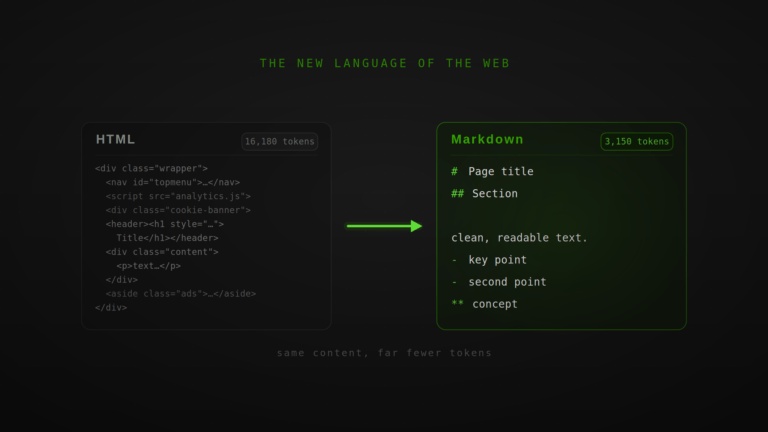
Markdown for AI Agents: the new language of the web
Markdown for AI agents: the web’s new language The web has always been built for human beings. HTML pages loaded with menus, scripts, advertising banners, tracking tags: everything designed for a browser...
Read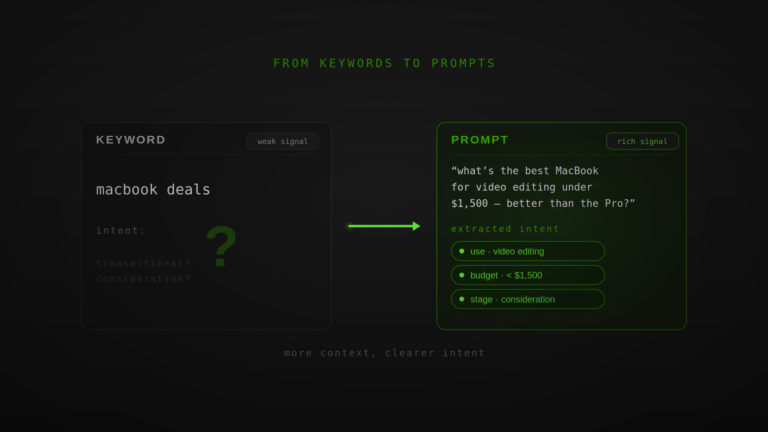
Prompt Analysis: a new world to explore
Prompt analysis: a new world to explore Search analysis was born as a tactical tool for ranking on search engines. With the advent of chatbots and large language models, the raw material...
Read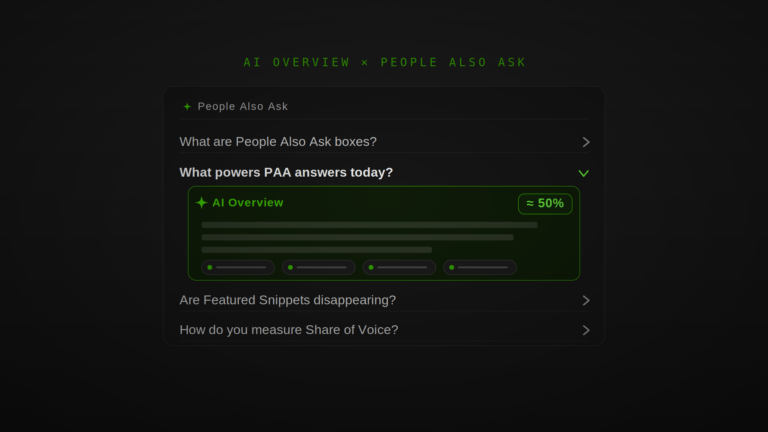
The impact of AI Overview on People Also Ask answers
The impact of AI Overview on People Also Ask answers People Also Ask boxes first appeared in Google's results in the United States in 2015. After an initial phase of testing and...
Read
Google, Bing and GEO: who is right?
Google, Bing and GEO : who is right? For a while, as the debate among digital marketing professionals raged over the scope of GEO (Generative Engine Optimization) and AEO (Answer Engine Optimization)...
Read
Technical GEO: Discoverability, Accessibility and Readability
Technical GEO: Discoverability, Accessibility and Readability Rewriting the Rules of the Game in the AI Era The revolution sparked by Large Language Models (LLMs) is radically reshaping the dynamics of online search,...
Read