

From Business Goal to AI-Driven Project: The Method for Building Digital Strategies with Real KPIs
88% of companies say they use AI, but only 5% extract real value at scale.I first read it in the McKinsey Global Survey of November 2025, 1,993 respondents across 105 countries, and I thought: this is the number that makes all the others pointless. Not because it’s surprising. Because it explains why almost nobody can answer the simplest question in the world: “and you — how much are you actually making from AI?”
While this is happening, search is reorganising itself around a new architecture. ChatGPT has 900 million weekly active users. Gemini has surpassed 750 million. 70.6% of the traffic coming from these generative engines is invisible to Google Analytics, classified as “Direct” and therefore ignored in most strategic decisions (Loamly, “State of AI Traffic 2026”, 446,405 visits analysed). And yet that traffic converts four times better than traditional organic traffic.
What follows is the method I use with Fortop clients to flip this order: first the objective, then the KPIs adequate to the AI era, then — and only then — the technology. It isn’t the only possible approach. It’s the one that produces measurable results.

The Paradox: Everyone Is Investing, Almost Nobody Is Measuring
The McKinsey Global Survey of November 2025, 1,993 respondents across 105 countries, captures an adoption that on paper looks mature. 88% of organisations regularly use AI in at least one business function. 72% use GenAI — more than double the 33% recorded in 2024. Three-quarters of the C-suite rank it among the top three strategic priorities.
BCG measured it across 1,250 companies: 60% extract no material value at all from AI. 35% scale, but with returns that struggle to justify the investment. The 5% that really works? They spend five times the average, have triple the engagement from leadership, and aren’t optimising processes — they’re rewriting the operating model.
The fastest way to understand why nearly everything fails is one figure, again from BCG: 60% of companies start implementing AI without having defined how they will measure the economic return. They pick the tool, kick off the project, allocate budget and people to it, and only afterwards — if ever — do they ask what it’s producing. This inversion explains the rest: abandonment rates, the zero impact on P&L, the boards that approve the next budget without knowing what the previous one delivered. It isn’t a technology crisis. It’s a methodology crisis.
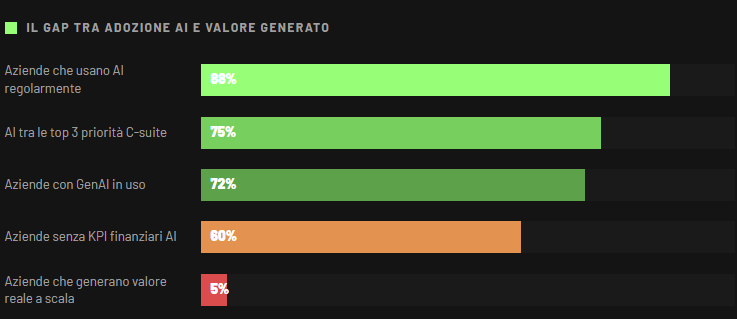
Sources: McKinsey Global Survey Nov. 2025 (n=1,993); BCG AI Radar 2025 (n=1,250+); Gartner CMO Spend Survey 2025
Projects with pre-approved metrics have a 54% success rate compared to 12% for those without (BCG/Pertama Partners, 2025-2026). A 4.5x difference that no tool, no vendor and no additional budget can bridge after the fact.
The winner profile is precise and replicable. McKinsey’s “high performer” companies spend over 20% of their digital budgets on AI — five times the average — have triple the engagement from senior leadership, and pursue the transformation of the operating model, not just efficiency. BCG quantifies it: “future-built” companies achieve 1.7x the revenue growth, 1.6x the EBIT margins, and 3.6x the shareholder return compared to laggards.

The Real Problem Isn’t the New Ecosystem. It’s That Your KPIs Don’t See It.
If you want to understand how ChatGPT, Gemini and Perplexity are rewriting the rules of visibility, we have published a dedicated analysis. Here we start from the next step: in that already-changed scenario, almost no company is measuring the right things.
The concrete problem is this. 70.6% of the traffic coming from generative engines enters Google Analytics 4 reports classified as “Direct” — no referrer, no campaign, no channel. It’s technically invisible. And yet that traffic converts at a 10.21% rate, against 2.46% for non-AI traffic. The highest-performing channel in your digital mix is the one you know nothing about.
This isn’t a technical problem you can solve with a UTM tag. It’s a structural problem: the metrics you use to justify your marketing budget were designed for an ecosystem that no longer exists. And until you change the metrics, you can’t change the decisions.
Traffic Down, Revenue Up: When the Wrong Metric Misleads the Board
There’s one data point I often use in the first conversations with clients because it breaks down a resistance that’s hard to overcome otherwise. Seer Interactive measured across 3,119 real queries that when a Google AI Overview appears, organic CTR collapses by 61%, from 1.76% to 0.61%. Paid CTR drops 68%. These are September 2025 numbers and the curve has not reversed.
The instinctive C-level reaction to these numbers is: we need to optimise better. More content, more backlinks, more SEM budget. But Rand Fishkin of SparkToro has documented something counterintuitive: HubSpot’s traffic collapsed by millions of visits while revenue grew. It isn’t a paradox. It’s the proof that traffic and revenue have decoupled.
GEO Isn’t a Technical Discipline: It’s a Business Choice
There’s a wrong way to frame GEO, and I see it often in client presentations: treating it as the “new SEO”, a technical update to be delegated to the content team. It isn’t. GEO — Generative Engine Optimization — is the strategic response to a shift in market structure: purchase decision-makers ask language models before they ask Google, and what the model answers depends on what the brand has built over time, not on what it optimised yesterday.
The point that most shifts business priorities is this: 86% of AI citations come from sources brands already control (Yext, 6.8 million citations analysed, July-August 2025). Websites (44%), listings (42%), reviews and social (8%). It isn’t a problem of discovering new channels. It’s a problem of optimising what already exists so an LLM interprets it correctly when someone asks “who’s the best supplier of X?”
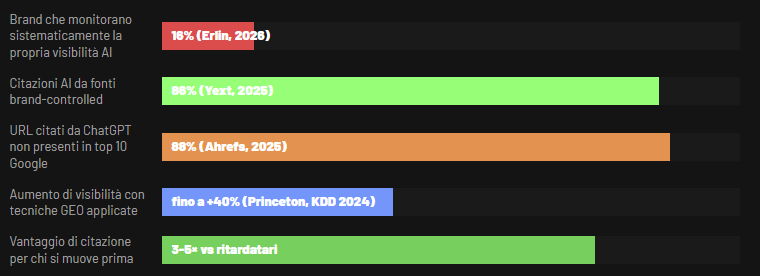
The numbers on the time window are what convince boards more than the visibility numbers. The GEO market was valued at $886 million in 2024 and is forecast to reach $7.3 billion by 2031, a CAGR of 34%.
It’s worth pausing on a data point that changes operational priorities. The Ahrefs study of December 2025 on 75,000 brands documents that web brand mentions correlate with AI visibility at 0.664, while traditional backlinks stop at 0.218. Three times the correlation.
The Attribution Black Hole: 70.6% of AI Traffic Is Invisible
This is the problem nobody wants to confront head-on, because it touches the foundations of how budget decisions are made. The Loamly “State of AI Traffic 2026” report, 446,405 visits analysed, precisely quantifies the scale of the problem.
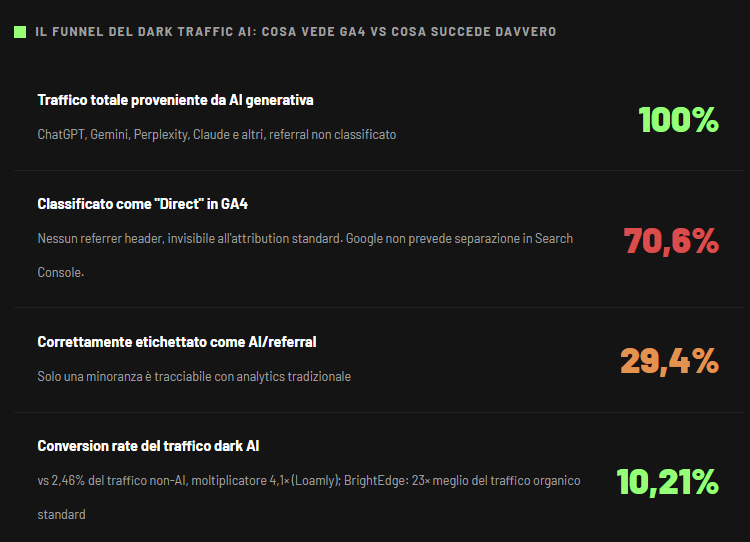
The paradox is this: the most invisible channel is also the highest-performing one. Microsoft Clarity documents that AI-referred visitors subscribe 2.4 times and register 10 times more than visitors from traditional search.
The Method: From Business Goal to AI Project, in Six Steps
The structure that follows is not theoretical. It’s the path I walk with clients when the brief is “we want to do AI” and the real objective is “we want to grow”.
Frequently Asked Questions on AI-Driven Digital Strategies
What is an AI-driven digital strategy?
An AI-driven digital strategy is a plan that integrates artificial-intelligence tools and models not as technological add-ons, but as a lever to reach measurable business goals. It differs from a traditional approach because it starts from defining KPIs before choosing the technology, and it includes specific metrics for the generative era: AI Share of Voice, brand search volume, citation rate in LLMs, and self-reported attribution for dark traffic.
Why do 95% of AI projects fail to produce measurable P&L impact?
According to the MIT Project NANDA study (2025), 95% of GenAI pilots produce no measurable impact on P&L. The main cause isn’t technological: BCG AI Radar 2025 documents that 60% of companies don’t define financial KPIs before implementation. AI projects with pre-approved metrics have a 54% success rate compared to 12% for those without.
What are KPIs for AI Search and how are they measured?
KPIs for AI Search measure the visibility and impact of a brand in generative engines (ChatGPT, Gemini, Perplexity, Google AI Overviews). The main ones are: AI Citation Share of Voice, Brand Search Volume, Engaged Sessions, Pipeline-Influenced Revenue and Self-Reported Attribution. Tools such as the Semrush AI Visibility Toolkit, Ahrefs Brand Radar and BrightEdge AI Catalyst allow for systematic monitoring.
What is AI dark traffic and why does it matter?
AI dark traffic is the traffic coming from generative engines (ChatGPT, Gemini, Perplexity) that arrives without a referrer header and gets classified as “Direct” in Google Analytics 4. According to the Loamly 2026 report, 70.6% of AI traffic is invisible to standard analytics. This is the most valuable traffic: it converts at 10.21% against 2.46% for non-AI traffic — a 4.1x multiplier.
What’s the difference between SEO and GEO (Generative Engine Optimization)?
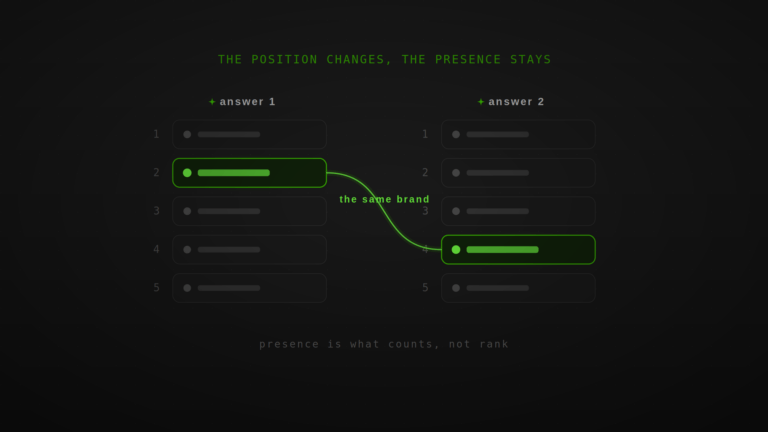
SEO optimises content to rank in a traditional SERP through keywords, backlinks and technical structure. GEO optimises content to be cited in responses generated by AI (ChatGPT, Gemini, Perplexity, Google AI Overviews). There is no “position 1” in GEO: there is only cited or not cited.
How much traffic do ChatGPT, Gemini and Perplexity generate in 2026?
At the start of 2026, ChatGPT counts 900 million weekly active users and 5.35 billion monthly visits, representing roughly 20% of search-related traffic worldwide. Google Gemini has passed 750 million MAU (Q4 2025). Perplexity AI processes 780 million queries per month with 45 million active users.
How do Google AI Overviews impact organic CTR?
Google AI Overviews drastically reduce organic click-through rate. The Seer Interactive study (September 2025, 3,119 queries, 42 organisations) measures a 61% drop in organic CTR (from 1.76% to 0.61%) and a 68% drop in paid CTR when an AI Overview appears.
How do you build an AI-driven project starting from a business goal?
The correct method inverts the typical process: 1) define the specific, measurable business goal; 2) identify the KPIs that prove the objective has been reached, including the new KPIs of the AI era; 3) only then choose the appropriate technologies. AI projects with pre-approved metrics have a 54% success rate compared to 12% for those without.
What share of Google searches generates no clicks in 2026?
Around 65% of Google searches generate no clicks to external websites. According to SparkToro/Datos, for every 1,000 Google searches in the US only 360 clicks reach the open web. When an AI Overview is present, the zero-click rate rises to 83%. Google AI Mode produces zero clicks in 93% of searches.
The Right Question to Ask at the Next Board Meeting
The data converge on a narrative few have the courage to state explicitly in a C-suite meeting: the AI problem in companies isn’t technological, it’s epistemological. We don’t know what we’re measuring, so we don’t know what we’re getting.
The time to move isn’t when the window has already closed.
More articles in Market Insights
Does your brand show up on ChatGPT?
Does your brand show up on ChatGPT? It depends on how many times you ask Digital has taught us to measure everything. It has been the innovation of the last 20 years,...
Read
Perfect content isn’t enough: why in generative engines visibility is built outside your website
Perfect content is not enough: why in generative engines visibility is built outside your website You've done everything right. The angle is clear, the content is well structured, the data is fresh....
Read
Angle, not topic
AI SEO Angle, not topic Why your content feeds your competitors in the era of LLMs 65% of B2B content is never consumed by buyers. A figure that has been circulating for...
Read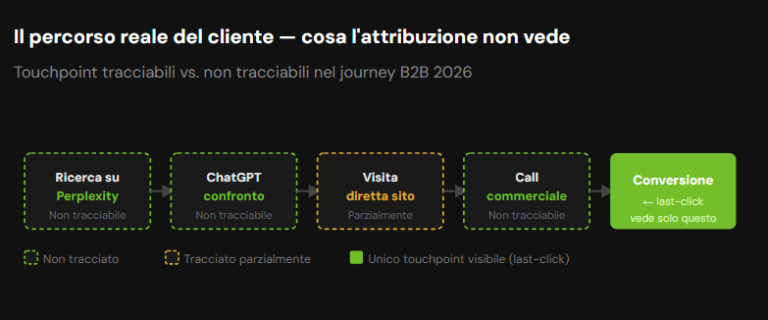
Data-Driven Marketing in the AI Era: How Data Becomes Decisions (and How Results Get Measured)
Data-Driven Marketing in the AI Era: How Data Becomes Decisions (and How Results Get Measured) There's a moment almost every marketing lead has lived through at least once. You sit down in...
Read
From SEO to GEO: How LLMs Are Rewriting the Rules of Brand Visibility
From SEO to GEO: How LLMs Are Rewriting the Rules of Brand Visibility Why the SERP Is No Longer Enough — and What Really Changes in the Era of Answer Engines Do...
Read