

Angle, not topic
Why your content feeds your competitors in the era of LLMs
65% of B2B content is never consumed by buyers. A figure that has been circulating for years and surprises in the same way every time, as if the cause were still a mystery. It isn’t.
Content that doesn’t work usually doesn’t have a technical quality problem. It has an angle problem. It talks about a topic without asserting anything about that topic. And it’s this difference — not length, not publishing frequency — that determines whether a piece of content builds brand authority or disappears into the noise.
There’s an implication almost no one has explicitly connected yet. Content without an angle doesn’t vanish into thin air: it gets absorbed by AI engines as anonymous raw material, synthesized into answers that don’t cite your brand because there’s nothing specifically citable. You’re producing content that feeds the answer ChatGPT will give to your competitor’s customer.
The numbers
- 65% of B2B content is never consumed by buyers Marketing LTB, 2025
- +40% more LLM citations for content with specific quantitative data and inline sources GEO-16 framework, Princeton/arXiv 2025
- 60% of searches end without a click when an AI Overview is present Series X Marketing, 2026
Topic and angle are not the same thing
A topic is the subject you talk about. The angle is the thesis you argue about that subject.
The distinction seems subtle. It isn’t.
“Digital is transforming the pharmaceutical sector.” “Food storytelling strengthens the bond with the brand.” “Clear communication improves the patient experience.” These are statements no one can dispute, technically correct, and for that very reason incapable of saying anything. John Bonini calls them “everyday angles”: content the prospect has already encountered hundreds of times, that doesn’t make them pause a second longer, that doesn’t shift any perception.
An angle, on the other hand, takes a position. It says something someone might find surprising, might dispute, that’s worth reading because it isn’t already “known,” isn’t taken for granted. An example? “Companies that produce more content in pharma often get fewer LLM citations than smaller competitors who write about specific topics with their own data” is an angle. It forces you to ask why, creates expectation about what will be demonstrated, sets whoever developed it apart from everyone else in the industry.
The test is immediate: content with an angle is signed. It has an author with a recognizable position. Content without an angle, by contrast, could be published by anyone operating in the same industry with equivalent results.
Why smart marketing teams still produce generic content
It’s not a matter of competence. It’s a structural problem.
Producing angles requires having a position, and a position requires deep knowledge of the customer: their real problems, the solutions they’ve already tried, the market beliefs that hold them back. This knowledge lives mainly in two places: direct conversations with customers and sales calls. Marketing that doesn’t talk continuously with sales is marketing done halfway.
The standard corporate content marketing process works differently. You identify keywords, you plan topics based on search volumes, you write content that covers those subjects with the correct technical structure. The cycle can run for years producing impeccable material that never builds brand authority, because it starts from analyzing search instead of analyzing conversations with the market.
The answer to the question “what is the counterintuitive truth my industry ignores?” is in no keyword research tool. It’s in the recordings of calls with prospects. It’s in the objections that stall deals. It’s in the market beliefs that prevent prospects from making decisions that would actually be in their interest.
“You quickly realize that to answer these questions you have to talk to customers and listen to sales calls. Otherwise you’re back at the level of the topic, not the angle.”
Those who manage to produce content with genuine angles work closely with the sales team. Access to sales calls isn’t a bonus: it’s the primary source.
In the era of LLMs, interchangeable content feeds your competitors
Generic content has always had a cost: it didn’t attract readers, didn’t generate conversations, didn’t build recognizable authority. These were acceptable costs when organic traffic was the central metric and ranking on Google was enough to bring in visitors.
The context has changed structurally. 60% of searches end without a click when an AI answer is present. Buyers reach decisions more informed and faster than before, but the content they consult during the decision process is increasingly a summary generated by a language model, not a page they visit.
Here’s where the specific problem of content without an angle in the era of LLMs emerges. A language model that receives your content and your competitors’ content as input doesn’t distinguish between brands if the two describe substantially the same concepts in the same way. It synthesizes. It produces an answer that aggregates the common information, and cites no one in particular — or cites whoever has an original claim, specific data, an identifiable position.
The research on how LLM citation systems work is fairly clear on this. Content with specific quantitative data and inline sources gets 40% more citations than content using generic statements (GEO-16 framework, arXiv 2025). Not because numbers are aesthetically preferable: because numbers can be extracted, are verifiable, attributable to a source. Just as a clear angle is attributable to whoever developed it, and an obvious statement is not.
The practical result: generic content doesn’t disappear. It becomes anonymous fuel for the answer ChatGPT builds for the buyer evaluating your category. If your competitor’s content has an angle and yours doesn’t, the AI’s answer will favor whoever has something to cite.
Further reading: To understand how LLMs select and weight sources in the answer-generation process, read the technical mechanics of fan-out and Reciprocal Rank Fusion
The formula: three questions before writing anything
Escaping the trap of the topic without an angle requires a method. It’s not a creative process: it’s analytical. And it comes down to three questions to ask about any subject before writing a word.
THE ANGLE FORMULA
[specific problem] + [counterintuitive truth] + [better resolution]
Question 1: what is your buyer’s specific problem?
Not the general subject, but the real friction point. The CMO reading about content marketing doesn’t have an “editorial strategy” problem: they have a specific problem, which might be “our content doesn’t generate qualified leads despite the investment” or “the sales team says prospects don’t remember our brand after the first call.” The specificity of the problem determines the relevance of everything that follows.
The specific problem isn’t invented. It’s collected. It’s heard in conversations with customers, in the questions prospects ask during demos, in the objections that stall deals in the final stage. Without this raw material, any angle is arbitrary.
Question 2: what is the counterintuitive truth?
The thing that is true, that the data or direct experience confirm, but that the majority of content in your category ignores, underestimates, or systematically gets wrong. In the case of content marketing: the problem isn’t the quality of the writing or the publishing frequency. It’s the absence of a clear position on something that matters to the buyer.
The counterintuitive truth is often the thing the market doesn’t want to hear because it forces a fundamental change in the process. It’s uncomfortable by definition. If it isn’t uncomfortable, it’s probably still a topic.
A few concrete examples for different industries. In pharma: “The companies that produce the most technical and in-depth content aren’t necessarily the ones doctors consult: they’re the ones that answer the questions doctors don’t ask their colleagues so as not to look unprepared.” In food B2B: “The problem with brand storytelling in food isn’t the quality of the stories: it’s that they’re produced for retailers instead of for the end consumers who then determine shelf rotation.” Both are statements someone could dispute. Both open a conversation the standard topic can’t even begin.
Question 3: what is the resolution that only makes sense after accepting the counterintuitive truth?
Not the generic answer, but the one that becomes obvious only if you started from point two. In our content marketing example: before working on the structure, frequency, or distribution of content, you have to work on the angle. And to find the angle you have to talk to customers and listen to sales calls. This resolution makes no sense without the context of the two previous points. Applied on its own, it seems obvious. As part of the logical sequence, it becomes necessary.
Topic vs Angle: examples by industry
The table below applies the distinction to the industries most frequent in Fortop’s client portfolio. For each industry: the statement anyone could sign, and the one that requires having talked to the market.
| Industry | Topic (everyday angle) | Angle |
|---|---|---|
| Pharma | Clear communication improves the patient experience along the care journey | Doctors search ChatGPT for the questions they don’t ask their colleagues: whoever answers those becomes the reference brand |
| Food B2B | Food storytelling strengthens the emotional bond with the brand and increases loyalty | Brand storytelling in food is produced for retailers, not for the consumers who determine shelf rotation |
| B2B Software | Good software increases team productivity and reduces operational time | Teams with more productivity tools spend more time managing them than on the work those tools are supposed to simplify |
| Digital Marketing | An omnichannel strategy lets you reach customers across every touchpoint | Companies with the best omnichannel strategy have fewer touchpoints than competitors: they’ve chosen the ones where buyers actually decide |
The competitor test: the tool almost no one actually uses
There’s an operational test that can be applied to any piece of content before publication. It takes thirty seconds. It’s rarely done.
After writing your text, ask yourself: could one of your competitors publish it with the same credibility?
If the answer is yes, you haven’t found the angle yet. The content is a topic disguised as an article.
The question forces you to be specific about what makes the point of view unique. Originality for the sake of originality serves no one: the question is whether the content brings something that derives from the brand’s specific experience, from data only that brand has, from the position only that brand can credibly hold in its market.
An agency that works exclusively with pharma multinationals has an angle on LLM visibility that’s different from a generalist agency’s. It should emerge in every piece of content it produces. Not as explicit promotion, but as a recognizable perspective the reader wouldn’t find elsewhere. If instead the agency writes “optimizing for AI engines is increasingly important for pharma brands,” anyone could say it with the same credibility, and is probably already saying it.
The competitor test works for technical and specialist content too — in fact it works there most of all. Specialization doesn’t justify genericness: it makes it more expensive, because a specialized audience immediately recognizes when content adds nothing to what it already knows.
How to apply the test in practice. Take the last piece of content you published. Replace your brand’s name with that of your main competitor. Does the content still work? If so, the piece lacks an angle. Work backwards: what is the specific position only your brand can credibly hold on that subject? That position is the starting point for rewriting.
Angle and citability: the missing link in GEO strategies
Technical optimization for generative engines, content structure for LLM systems, semantic markup: all relevant elements. But there’s a prerequisite that’s rarely discussed in GEO checklists.
An LLM cites content because it has something to cite. Specific claims. Verifiable data. Recognizable positions attributable to a source. Generic content has none of this: it’s exactly like the information the model already has in its training data, aggregated and rephrased differently.
Research on LLM citation patterns confirms this mechanism. Content with specific quantitative claims and inline sources receives 40% more citations than content with generic qualitative claims. LinkedIn has become the most-cited domain by LLMs for professional queries, with its citation frequency doubling between November 2025 and February 2026: not because LLMs have a preference for the social network, but because LinkedIn hosts content with explicit angles, individual positions, signed claims.
Content with an angle produces claims. Claims have something extractable for an LLM. Generic content, by contrast, gets aggregated with competitors’, synthesized, and dissolved into the anonymity of the overall answer.
Technical optimization for GEO matters. But optimizing content that has nothing citable is like working on the packaging of a product no one wants to buy.
Further reading: You can read the full context on the shift from SEO to GEO and the paradigm change in search, written by Giorgio.
FAQ
FAQ
What’s the difference between topic and angle in content marketing?
The topic is the subject you talk about: food storytelling, digital transformation, omnichannel. The angle is the specific thesis you argue about that subject — something someone could dispute, that isn’t obvious. “Digital is transforming pharma” is a topic. “Pharma companies with the largest content budgets get fewer LLM citations than smaller but more specific competitors” is an angle. The practical difference: anyone could sign the topic, no one else could sign the angle.
Why isn’t content without an angle cited by LLMs?
Language models cite content with specific claims, verifiable data, and recognizable positions. Generic content gets aggregated with competitors’ without attribution. According to the GEO-16 framework (Princeton/arXiv, 2025), content with quantitative data and inline sources receives 40% more citations than generic qualitative content.
How do you find the counterintuitive truth about a subject?
You won’t find it on Answer the Public or through keyword research. You find it in conversations with customers and in sales calls. It’s the market belief that stops prospects from acting — the one the industry repeats like a mantra but that experience contradicts.
How much does the angle matter for GEO?
A lot, for a precise technical reason. LLM systems select sources based on authority, claim specificity, and the presence of citable data. Interchangeable content gets synthesized together with others without attribution. The angle isn’t just editorial value: it’s citability infrastructure.
Does the competitor test work for technical content too?
It works for technical content most of all. The question is: could one of your competitors publish this piece with the same credibility? If so, it lacks an angle. Specialization doesn’t justify genericness.
How often should you update content to maintain LLM visibility?
76.4% of the pages most cited by ChatGPT had been updated in the previous 30 days (Digitaloft, 2025). URLs cited in AI results are 25.7% more recent than those in traditional search. Update data, sources, and angle when market conditions change.
Which industries most need to work on their angle?
The industries that produce the most generic content: pharma, food, B2B software, professional services. Precisely because everyone talks about the same things in the same language, those who produce specific angles stand out with relatively little effort.
How do you integrate listening to sales calls into the content strategy?
The content team joins or listens to recordings of sales calls on a monthly basis, looking for: recurring objections, market beliefs that block decisions, questions prospects ask before converting. They’re already available, rarely used for content.
What changes when you start from the angle
The 65% of B2B content that goes unconsumed isn’t a problem of wasted resources. It’s a problem of a brand that doesn’t build the position it would like to occupy in buyers’ minds, and that, in the era of LLMs, doesn’t even build the presence it would like to occupy in AI answers.
Starting from the angle changes the process before it changes the result. It forces you to answer uncomfortable questions: what does the brand know that no competitor knows to the same degree? Which market beliefs can the brand challenge with real data? What is the position only that brand can credibly hold on something that matters to buyers?
These aren’t questions you solve in a brainstorming session. You solve them by talking to customers, listening to sales calls, gathering the data that only direct experience with the market can produce.
Content born from that process doesn’t need to be optimized to look authoritative. It already is, because it says something only someone who deeply knows that market could say. It’s exactly what language models look for to build their answers. And, as a result, the only kind of content no competitor could sign in your place.
More articles in Market Insights
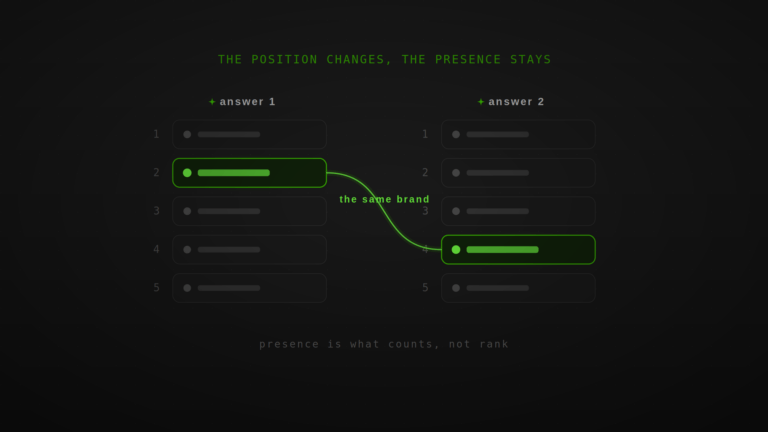
Does your brand show up on ChatGPT?
Does your brand show up on ChatGPT? It depends on how many times you ask Digital has taught us to measure everything. It has been the innovation of the last 20 years,...
Read
Perfect content isn’t enough: why in generative engines visibility is built outside your website
Perfect content is not enough: why in generative engines visibility is built outside your website You've done everything right. The angle is clear, the content is well structured, the data is fresh....
Read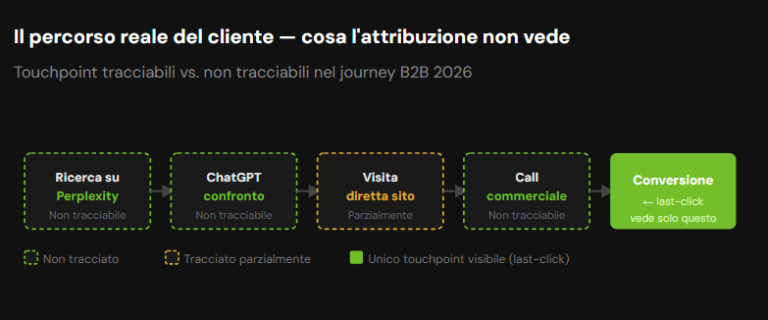
Data-Driven Marketing in the AI Era: How Data Becomes Decisions (and How Results Get Measured)
Data-Driven Marketing in the AI Era: How Data Becomes Decisions (and How Results Get Measured) There's a moment almost every marketing lead has lived through at least once. You sit down in...
Read
From Business Goal to AI-Driven Project: The Method for Building Digital Strategies with Real KPIs
L’88% delle aziende dichiara di usare l’AI, ma solo il 5% ne ricava valore reale a scala. L’ho letta per la prima volta nel McKinsey Global Survey di novembre 2025, 1.993 rispondenti in 105 paesi, e ho pensato: questo è il numero che rende inutili tutti gli altri. Non perché sia sorprendente. Perché spiega perché quasi nessuno sa rispondere alla domanda più semplice del mondo: “e tu, quanto stai guadagnando dall’AI?” Mentre accade questo, la search si sta riorganizzando attorno a una nuova architettura. ChatGPT ha 900 milioni di utenti attivi settimanali. Gemini ha superato i 750 milioni. Il 70,6% del traffico che arriva da questi motori generativi è invisibile a Google Analytics, classificato come “Direct”, quindi ignorato nella maggior parte delle decisioni strategiche (Loamly, “State of AI Traffic 2026”, 446.405 visite analizzate). Quel traffico, però, converte quattro volte meglio del traffico organico tradizionale.
Read
From SEO to GEO: How LLMs Are Rewriting the Rules of Brand Visibility
From SEO to GEO: How LLMs Are Rewriting the Rules of Brand Visibility Why the SERP Is No Longer Enough — and What Really Changes in the Era of Answer Engines Do...
Read