

MCP: What It Is and Why It Will Change the Way Your Tools Talk to Each Other
There’s a bottleneck every digital agency knows: operational teams — Account Managers, Project Managers — who depend on technical teams to obtain data that, in theory, is already available. The result is predictable: internal tickets, waiting times, and technical staff spending a significant share of their time pulling reports instead of working on high-value projects.
We decided to eliminate this problem at its root, by building an infrastructure that connects Google Analytics 4 directly to a conversational AI assistant via the Model Context Protocol (MCP).
The Context: Managing GA4 at Scale
When you administer dozens of GA4 properties spread across multiple accounts and multiple clients, even an experienced analyst spends real time navigating the structure, identifying the right property and configuring the right report. For a non-technical profile, the GA4 interface represents a concrete barrier to accessing the data.
The problem isn’t people’s skills: it’s the architecture of the tools, designed for those who configured them, not for those who need the information they contain.
What We Built
The infrastructure consists of two Python microservices, designed to be consumed via MCP by a language model (in our case, Claude on a Teams plan).
The first service handles property resolution: given a client name or a partial identifier, it scans all of the company’s GA4 accounts and returns the correct property. This removes the manual lookup step which, on a large client base, is a constant source of friction.
The second service handles report extraction: it receives the query parameters — time range, dimensions, metrics — and runs the calls to the GA4 APIs, returning structured data ready for interpretation.
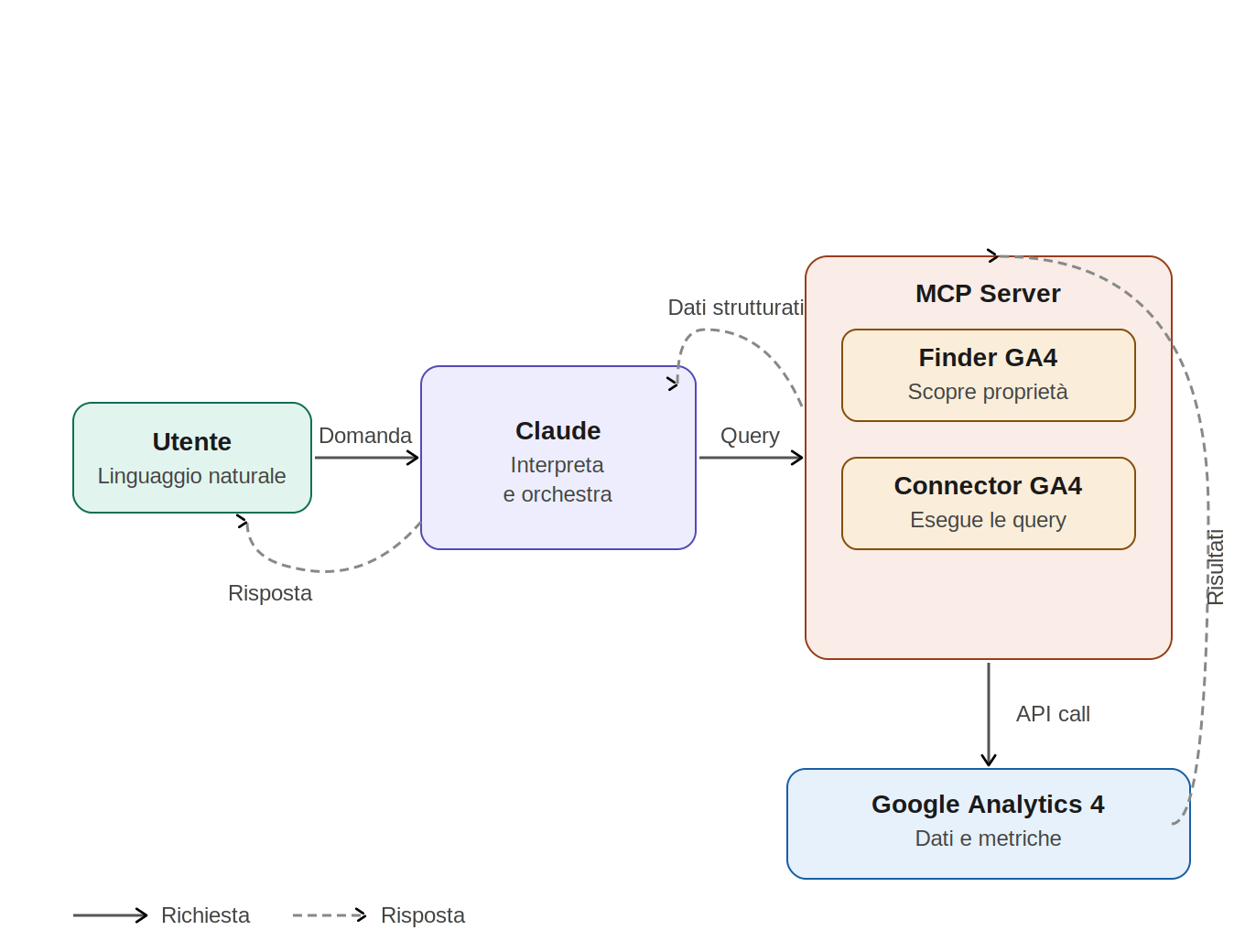
As the basis for the extraction logic we adopted the core of Michele Pisani’s GA4 Magic Reports, a tool with solid coverage of the GA4 Data APIs. Starting from a battle-tested, reliable foundation let us concentrate our work where it counts: the integration architecture, error handling at scale, and the MCP layer.
The Role of MCP
The Model Context Protocol is an open standard that allows an AI model to invoke external tools in a structured way. In practical terms, it defines a contract between the AI assistant and the services we make available to it: which operations it can run, with which parameters, and in what format it receives the responses.
This means the user doesn’t need to know how GA4 works, which APIs to call, or where a property lives. They write a question in natural language:
“Claude, pull last month’s GA4 data for account X and tell me the top 5 channels by traffic and engagement.”
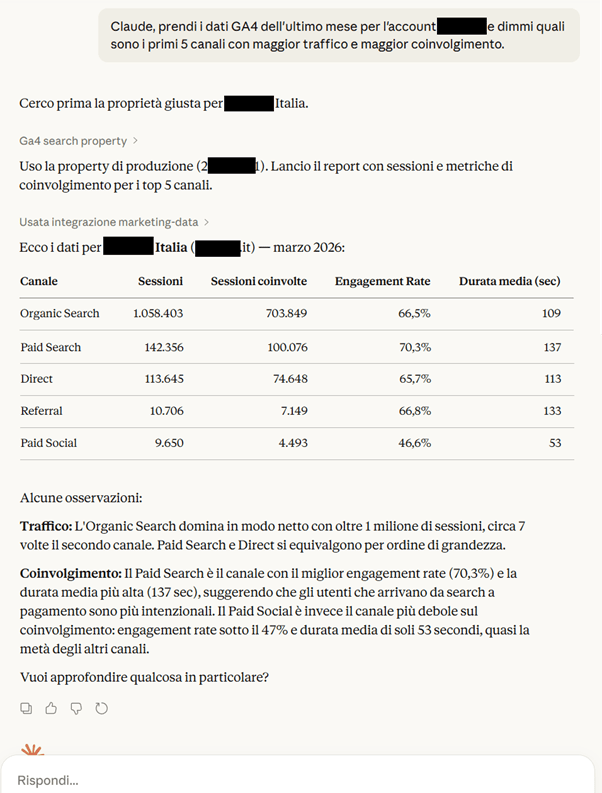
The assistant identifies the right property, runs the query, and returns a readable answer in seconds.
What Has Actually Changed
To give a sense of the scale of the problem we solved: in data-intensive environments, analyst teams can end up spending 50-70% of their time handling ad hoc requests. The figure is consistent with other statistics that recur across the industry. Roughly 60-80% of analytics teams’ time is still absorbed by manual reporting activities — extraction, cleaning and formatting — rather than by strategic analysis.
The MCP infrastructure has removed the bottleneck of recurring GA4 data requests that used to flow through the technical team as a mandatory intermediary, giving that time back to both teams.
The benefits play out on three levels:
For operational teams, access to data has become immediate and self-service. An Account Manager can check how a campaign is performing or prepare a number for a call with a client without opening a ticket and without waiting.
For the technical team, the time previously absorbed by routine extractions is now available for higher-value activities: development, optimisation, automation.
For data reliability, every response passes through a deterministic code infrastructure. There’s no manual interpretation of the interface, no risk of selecting the wrong property or the wrong filter. If the query is correct, the data is correct.
Beyond GA4: the Outlook
What we built for Google Analytics — and which we are now extending to other Google Suite stacks — is a replicable model. The same architecture, dedicated microservices exposed via MCP, can connect an AI assistant to any business system that exposes APIs: CRM, advertising platforms, project management tools, internal databases.
MCP isn’t a novelty for its own sake. It’s the infrastructure that allows AI to move from generating text to acting concretely on business systems. The difference between the two things is the difference between an interesting tool and a useful tool.
We have chosen to build, one piece at a time.
More articles in The Builder’s Perspective

AI has shortened the time, not the problems
AI has shortened the time, not the problems It has only made them harder to see Every new tool arrives with the same promise: do the same things in far less time....
Read
How Artificial Intelligence Is Changing the Way We Read Data (and Make Decisions)
How Artificial Intelligence Is Changing the Way We Read Data (and Make Decisions) AI has made data analysis more conversational and faster. But anyone who works with data every day knows that...
Read
Your tracking system is lying to you. And it’s not your fault.
Your tracking system is lying to you.And it's not your fault. If your company is still using classic Google Tag Manager, the Meta pixel in the browser and GA4 in its standard...
Read