

Google.com/goto : the redirects changing the rules of the game for SEO
What they are, why Google introduced them, and what they mean for anyone working in organic search
1. The appearance of goto links between June and August 2026
Between June and August 2026 the SEO community focused on a decidedly significant technical change: the links in Google’s search results no longer point directly to the destination page, but pass through an intermediate address of the form google.com/goto?url=[encoded string]. After a first report by Alex Greenland on 23 June 2026, the news bounced to Search Engine Roundtable on 8 July.
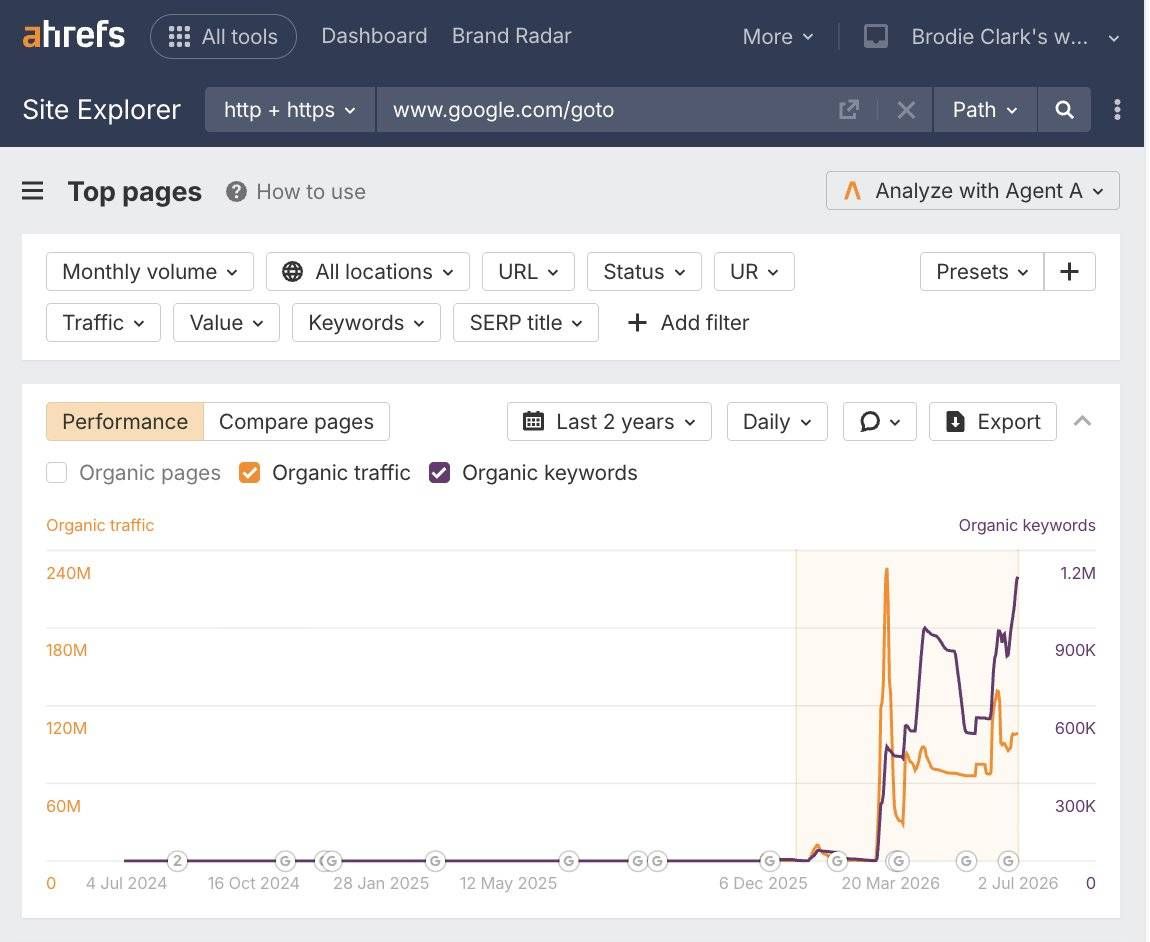
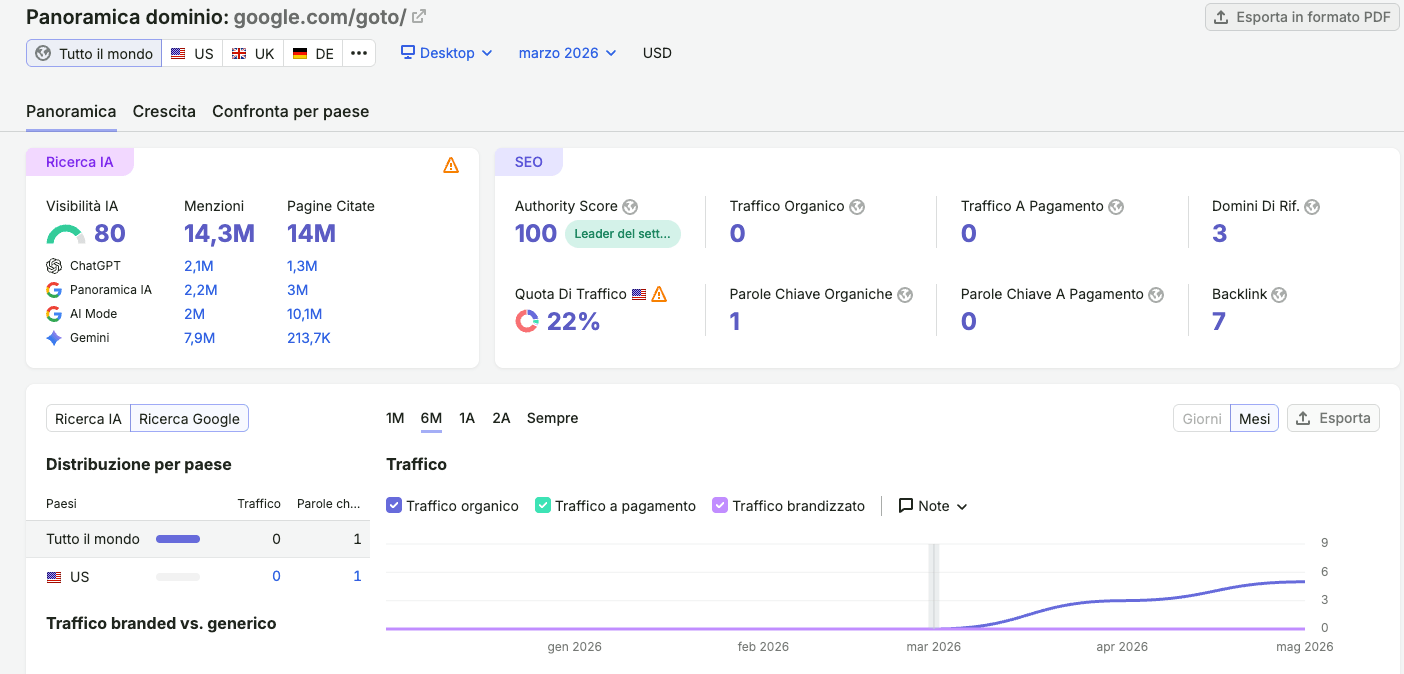
The phenomenon began well before these reports. In the 8 July article Search Engine Roundtable published an Ahrefs screenshot, shared by Brodie Clark, showing that the www.google.com/goto path has been picking up organic traffic and keywords since March 2026. Our own check on Semrush confirms the same timing: estimated organic traffic on the google.com/goto/ path leaves zero around March 2026 – three months before the first public report and five before the official confirmation.
The turning point comes on 26 August 2026, when a Google spokesperson confirms the rollout to Search Engine Roundtable and Search Engine Land with a terse, vague statement: “We have a long history of deploying technical measures against evolving forms of abuse, and we regularly take steps to protect our services and users”. Google does not specify the target of these measures nor provide technical details.
In the following days the rollout accelerates: Derek Perkins (Nozzle) reports coverage “close to 100%” across several residential-IP providers, and SerpApi observes the redirect on Google Videos, Google Lens and AI Overview too. On 28 August Schwartz is already talking about a tug-of-war between Google and the SEO-tools ecosystem.
2. What goto links are and why Google introduced them
Until a few weeks ago the HTML of a SERP contained, for each organic result, a direct and readable link to the destination URL: anyone analyzing the markup – a rank-tracking tool, for example – could extract that address with no further steps.
With the new system that link becomes an address of the form google.com/goto?url=[encoded parameter]. The real destination is in the parameter, in a form not readable client-side. To know the destination you have to follow the redirect – one extra HTTP hop, server-side, that ends with a 302 (temporary) redirect to the final page.
The behavior is not uniform, though: from an unauthenticated session the goto links are immediate to find, from a logged-in user much less so. Google has not documented the difference; DemandSphere observes that for logged-in users the substitution “may or may not be there” and points to incognito browsing as a reliable verification method – the condition to use to replicate the checks in this article.
Two documented facts help frame the matter, and must be distinguished from the interpretation that follows from them.
First fact: on 20 July 2026 the federal court for the Northern District of California definitively dismissed the part of Google’s DMCA claims against SerpApi – one of the main SERP-data providers – relating to results without protected content, qualifying URLs, snippets and aggregated data as publicly accessible facts. The other claims were dismissed with leave to amend, and on 10 August Google filed an amended complaint: the litigation remains open, but on narrower ground.
Second fact: since mid-September 2025 the num=100 parameter has stopped working, forcing third-party tools to multiply their requests to obtain the same data. Google did not announce its removal and later claimed it had never supported it – a script that repeats itself with the goto links.
A hypothesis – shared by observers such as Barry Schwartz, never framed by Google in these terms: the goto links would be a second and more incisive chapter of the same strategy, designed to make it more costly to extract data from the SERP at scale.
3. The consequences for SEO professionals
For those working in SEO the practical impact is almost entirely on measurement, not on real visibility. To be clear, that is no small thing: defining intervention strategies and verifying the impact of the resulting actions depend largely on this kind of measurement. Search Engine Land reports that Search Console is not affected and that, broadly, title, snippet and SERP position remain unchanged. As we will see shortly, however, there are exceptions regarding the indexing of the intermediate URLs. Otherwise, what changes is the cost and accuracy of the data obtained from the tools.
The effect adds to that of the removal of num=100: where back then it was the pages to download that multiplied, now it is the requests needed to interpret a single page. For rank-tracking vendors this means higher operating costs, which tend to translate into higher prices for clients or reduced coverage – fewer keywords, lower update frequency – the pattern already seen after September 2025.
There is then a risk not to be underestimated: the historical comparability of the data. Rankings collected before, during and after the rollout may not be fully comparable, introducing noise and consequent difficulties in interpreting the data.
Finally, the GA4 attribution front remains open: if passing through google.com/goto did not preserve a clean referrer, tracking problems and spillover of organic traffic into (direct)/(none) cannot be ruled out, with a consequent widening of the gap between GA4 and GSC data. A phenomenon to monitor closely.
4. The unintended side effects
The most notable aspect emerges from a direct check on 31 August 2026: querying Google with site:google.com/goto we detected a significant side effect. Many pages appear indexed under the google.com domain but return titles and snippets from third-party sites.
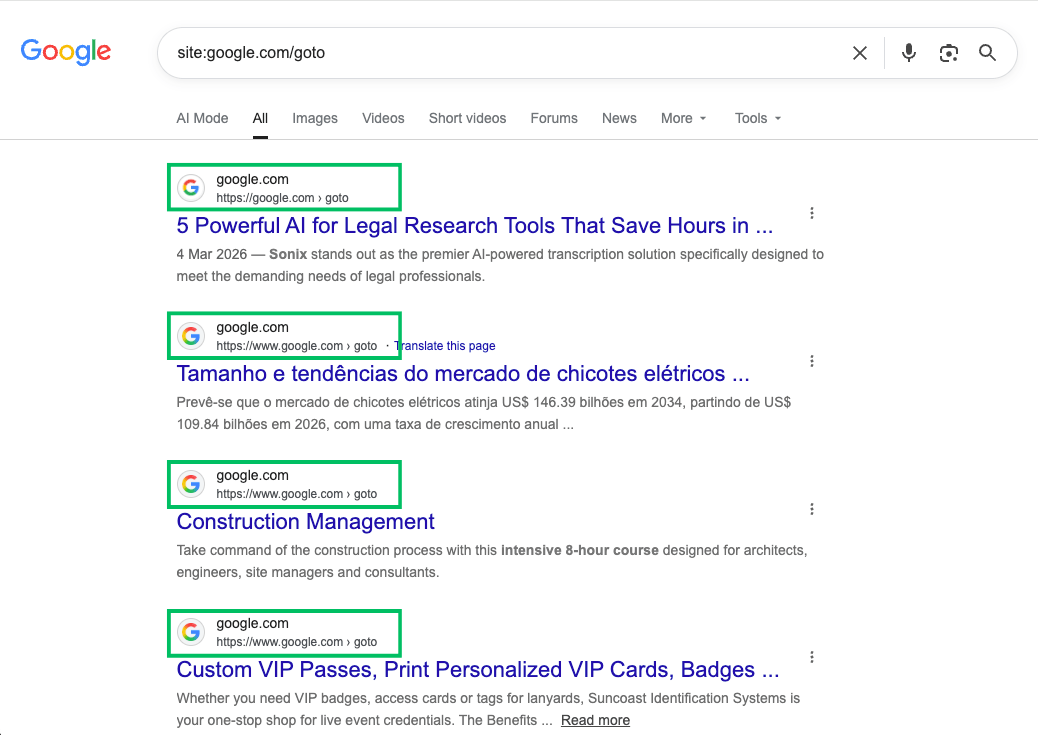
Clicking on these results leads to the pages from which Google “extracted” the link anchor text and the snippet:

How is this possible? What follows is a hypothesis, not an established fact.
The robots.txt of google.com contains the directive Disallow: /goto? – which blocks crawlers from /goto paths followed by a query string, i.e. the form of the URLs in question:
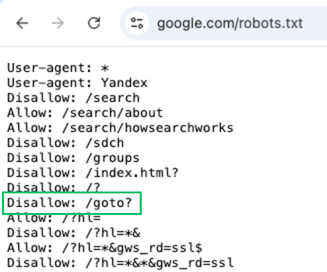
Blocking crawling does not, however, prevent indexing: it is Google itself that documents that a URL blocked by robots.txt can end up in the index if discovered via links, because the block concerns crawling. Indeed, by not downloading the resource, Googlebot cannot read a possible noindex. Add the typical behavior of the 302: faced with a temporary redirect, Google tends to keep the redirecting URL in the index. With no information from crawling, the listing is built from what is available elsewhere: the text of the links pointing to the URL and the destination page.
Don’t try to repeat this mistake… As of today, September 1, Google has already removed all traces of those links—perhaps using the URL removal feature in its Search Console. In any case, it was an issue that likely affected form more than substance, but Google certainly didn’t come out looking good, and the owners of the affected sites wouldn’t have been happy to be held hostage by the google.com domain.
5. Are rank trackers really in trouble?
It depends on the tool and the type of result: the picture emerging from the main vendors’ communications is anything but uniform.
DataForSEO claims to have spotted the behavior before the large-scale rollout and to have developed a solution in advance: today only 0.01% of the SERPs from its API may contain an unresolved goto link in the organic elements. On other features the picture changes: 0.39% for featured snippets, 25.1% for Local Packs and 52.26% for AI Overviews – a sign that tracking citations in generative answers remains the most fragile front for the whole sector.
Two clarifications: the numbers, DataForSEO itself warns, measure the share of SERPs from its API that may contain an unresolved link, not the frequency of use by Google; and they are self-declared, not verified by third parties.
SerpApi describes a more reactive approach: it resolves every new variant of the format as soon as it observes it, with no changes to the client-side integration, and invites users to report anomalies via the query’s Search ID. DemandSphere states that its main metrics – Share of Voice, Unified Visibility and organic ranking – have not been impacted thanks to countermeasures already in place, but coverage of the URLs in SERP features is still ongoing.
The most critical picture comes from Nozzle: during testing, with partial coverage, Perkins recounts that the tool discarded the affected results – a sustainable choice while volume was low, impractical with a rollout close to 100%. Ahrefs too, reports SEO consultant Glenn Gabe, has notified clients of a “temporary disruption of ranking data” caused by Google’s changes, without having yet found a definitive solution.
In short: rank trackers are under pressure, but unevenly. Vendors with dedicated engineering teams hold up better than smaller tools, and for everyone the tracking of citations in AI Overviews remains the most significant unresolved problem.
6. Conclusion: was it worth it?
The picture is that of a measure with concentrated costs and benefits that are, for now, hard to measure from the outside. Google presents the goto links as a generic technical measure against unspecified forms of abuse; the SEO community, without official confirmation, reads them as the second act of the strategy begun with num=100 and continued, a few weeks after the partial defeat on the DMCA claims against SerpApi, with a technical obstacle aimed at complicating automated extraction at scale.
Then there is the paradox of point 4: in releasing this change, Google seems to have introduced – at least temporarily – a quality problem in its own index, with third-party pages appearing under the google.com domain. No official source has commented on it yet, and it is worth monitoring.
The practical lesson is the same already learned with num=100: expect weeks of noise in rank-tracker data before the vendors complete their fine-tuning, and safeguard measurement. Whether it was worth it, for the ecosystem, remains an open question.
Fortop supports companies and brands in measuring organic visibility, in data governance and in activating digital channels. To assess the impact of this change on your reports: contact@fortop.it.
Frequently asked questions
What are google.com/goto links?
They are intermediate addresses that Google shows in the SERP in place of the direct link: they have the form google.com/goto?url=[encoded parameter] and on click redirect to the final page. Google confirmed the rollout on 26 August 2026.
Do goto links affect my site’s ranking and indexing?
No source reports effects on the crawling and ranking of destination sites, and Search Console is not affected; on the indexing of the intermediate URLs, however, there are the exceptions described in point 4. The impact concerns measurement: the cost and accuracy of third-party tools’ data.
Why do rank-tracker reports show anomalous fluctuations?
Because to know the real destination the tools must follow one extra redirect. Data collected before, during and after the rollout are not fully comparable: some variations are measurement artifacts, not ranking movements.
Can organic clicks appear in GA4 as direct traffic?
It is a risk to monitor, not an established phenomenon: if passing through google.com/goto did not preserve a clean referrer, organic clicks could become (direct)/(none).
Since when have goto links existed?
The first public reports date to 23 June 2026, but Semrush and Ahrefs data place the appearance of organic visibility on the /goto path around March 2026.
How do I check whether a SERP uses goto links?
It is best to use an unauthenticated session or incognito browsing: from a logged-in user the goto links are harder to spot.
Sources
- Search Engine Roundtable – Google Testing google.com/goto As Tracking URLs (8 July 2026)
- Search Engine Roundtable – Google Search Rolling Out google.com/goto Tracking Parameters (26 August 2026)
- Search Engine Land – Google confirms deploying goto URL redirects to search results links
- DataForSEO – Google’s goto rollout: we already resolve 99.99% of URLs
- SerpApi – Google’s new /goto redirect URLs: resolution in progress
- Crawl Vision – Google search goto tracking URLs
- PPC Land – Google forces rank trackers into 500 to 1,000 requests per query
- Digital Applied – Google’s goto tracking URLs: what happens to attribution
- DemandSphere – An update from DemandSphere on Google’s goto redirects
- Relevant Audience – Google confirms google.com/goto passthrough URLs
- Search Engine Roundtable – Google Lawsuit Against SerpApi Over Scraping Search Results Has Been Dismissed (22 July 2026)
- Search Engine Land – Google loses key DMCA claims against SerpApi in scraping lawsuit (22 July 2026)
- Search Engine Roundtable – Google Amends Lawsuit Against SerpApi (12 August 2026)
- Search Engine Land – Google Search confirms it does not support the results per page parameter (18 September 2025)
- Glenn Gabe (X) – Ahrefs goto ranking data disruption update
- Google – robots.txt (direct check of the Disallow: /goto? directive)
- Semrush – Fortop direct check of the organic visibility of the google.com/goto path (31 August 2026)
More articles in AI & SEO
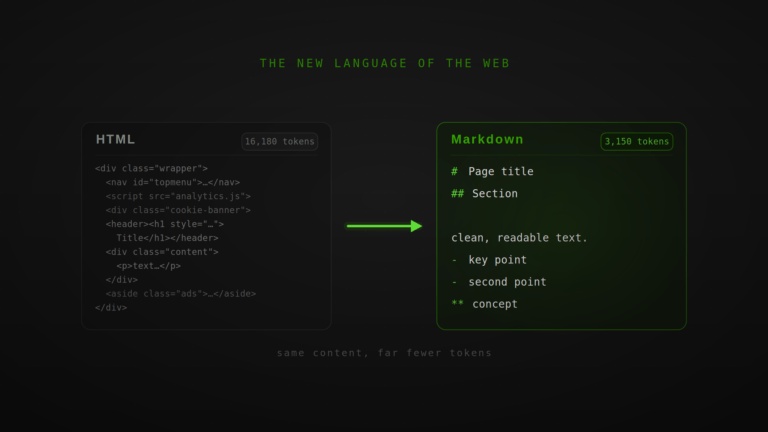
Markdown for AI Agents: the new language of the web
Markdown for AI agents: the web’s new language The web has always been built for human beings. HTML pages loaded with menus, scripts, advertising banners, tracking tags: everything designed for a browser...
Read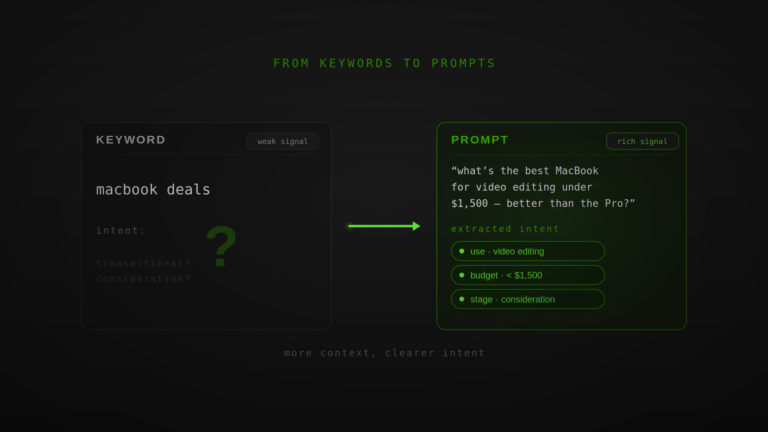
Prompt Analysis: a new world to explore
Prompt analysis: a new world to explore Search analysis was born as a tactical tool for ranking on search engines. With the advent of chatbots and large language models, the raw material...
Read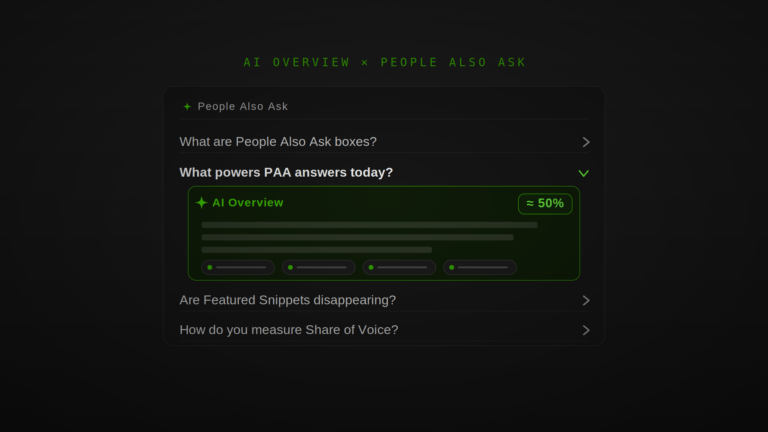
The impact of AI Overview on People Also Ask answers
The impact of AI Overview on People Also Ask answers People Also Ask boxes first appeared in Google's results in the United States in 2015. After an initial phase of testing and...
Read
Google, Bing and GEO: who is right?
Google, Bing and GEO : who is right? For a while, as the debate among digital marketing professionals raged over the scope of GEO (Generative Engine Optimization) and AEO (Answer Engine Optimization)...
Read
Technical GEO: Discoverability, Accessibility and Readability
Technical GEO: Discoverability, Accessibility and Readability Rewriting the Rules of the Game in the AI Era The revolution sparked by Large Language Models (LLMs) is radically reshaping the dynamics of online search,...
Read
Google Search Console and Bing Webmaster Tools: Governing Access to Your Data
Google Search Console and Bing Webmaster Tools: Governing Access to Your Data Saying we need to pay attention to who can access our organic performance data and all the other information offered...
Read